
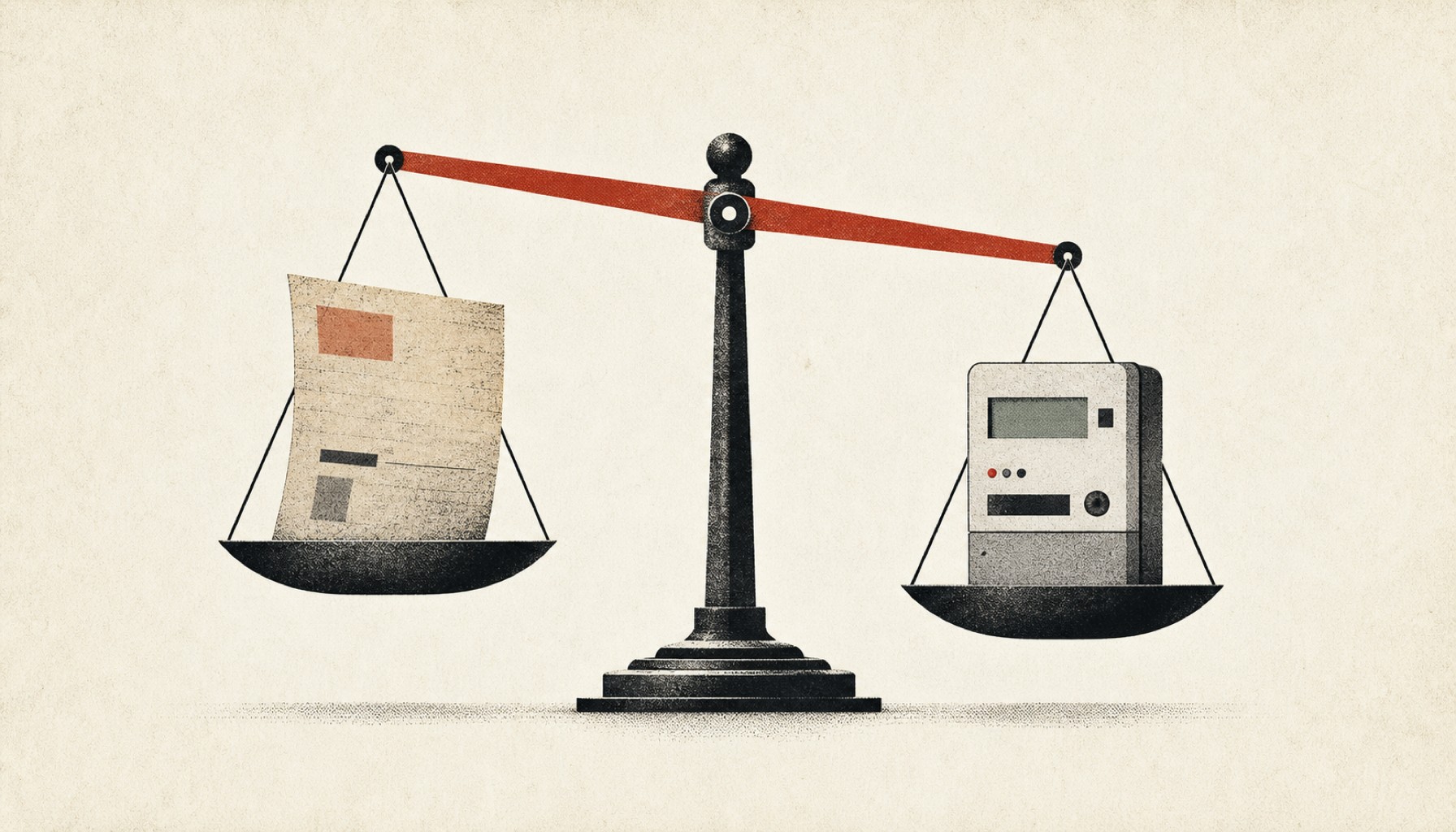
Home Charging for Company EVs: Why the Flat-Rate Reimbursement Ends in 2026
6 min read
Since January 1, 2026, the €70 flat-rate reimbursement for self-paid home charging electricity for company EVs is history. Anyone who continues to apply it anyway steps into tax no-man’s land. Fleet managers and payroll departments in Mittelstand companies face the task of switching reimbursement procedures, proof requirements, and Car Policy to two new paths. The change costs hours in administration, not weeks. But it cannot be postponed.
Key Points at a Glance
- Old flat rate expires at year-end. The €30 and €70 rules from 2020 now apply only to payroll periods before January 1, 2026.
- Two paths remain tax-free. From 2026, only precise kWh proof of the actual electricity price or the new electricity price flat rate of €0.34 per kilowatt-hour are permitted.
- Example: 3,000 kWh. Instead of a previous maximum of €840 without proof, the flat rate allows up to €1,020 per year and vehicle.
- Car Policy must be updated. The reimbursement model, accepted proofs, and data handover to payroll must be documented in writing.
Related:Investment Backlog: How AI Uncovers Hidden Budgets / STIHL: Site Loyalty Costs 175 Million
The Old Flat Rate Applies Only Until New Year’s Eve
With its letter of November 11, 2025 (reference IV C 5 – S 2334/00087/014/013), the Federal Ministry of Finance has clarified a question that had been open in many fleet teams for months: What happens to the simplified reimbursement for employee-paid home charging electricity? The answer is clear. The previous monthly flat rates of €30 and €70 are explicitly limited to payroll periods before January 1, 2026. There is no transitional arrangement.
Affected are all company electric vehicles and plug-in hybrids used privately where the employee pays for home charging electricity themselves. This is exactly the common setup in the Mittelstand: a wallbox at the employee’s home connection, charging electricity runs through the private contract, and the company reimburses a fixed monthly amount. This arrangement ends with the flat rate on December 31, 2025.
Two Paths That Remain from 2026
The BMF letter permits two procedures from 2026, both with advantages and disadvantages. Fleet managers must choose one path and define it bindingly in the Car Policy.
Path one: the actual electricity price. The company reimburses the actual costs incurred, based on the employee’s individual electricity tariff, including a pro-rata share of the base fee. This is the precise path. It requires proof of the charged amount in kilowatt-hours and documentation of the agreed tariff. The effort lies in data transmission, not in the technology.
Path two: the electricity price flat rate. Those who prefer to avoid individual proof can use the flat-rate reimbursement of €0.34 per kilowatt-hour. This value is based on the Destatis average electricity price for 2026. Here too, proof of the charged amount is required. The difference: the price per kWh is fixed, which simplifies billing. At 3,000 kWh per year, that is a maximum of €1,020 per vehicle.
| Criterion | Actual Electricity Price | Electricity Price Flat Rate |
|---|---|---|
| Basis | Individual tariff incl. base fee | €0.34 per kWh |
| Proof of Quantity | Meter or app | Meter or app |
| Proof of Price | Electricity bill or contract | Not required |
| Billing | More complex | Simpler |
| Example 3,000 kWh | Depending on tariff | Up to €1,020 / year |
Source: BMF letter dated November 11, 2025 (IV C 5 – S 2334/00087/014/013)
What Counts as Proof
Both paths have one thing in common: without proof of the charged kilowatt-hours, there is no tax-free reimbursement. Estimates are no longer permitted. Anyone who fails to provide proof in case of doubt risks the payment being classified as taxable wages. Payroll must then tax it retroactively.
The BMF accepts separate meters at the wallbox, mobile charging cables with integrated consumption measurement, and vehicle-integrated recording systems as proof. App-supported documentation is permitted if it reliably records the quantity. Interestingly, even non-calibration-law-compliant meters are sufficient as long as they plausibly document the charged quantity. This lowers the barrier for companies that do not want to presuppose expensive wallbox infrastructure.
What Breaks
- Flat rate without quantity proof
- Estimation of charging costs
- Unclear state in the Car Policy
What Works
- Smart meter, wallbox meter or app
- Electricity price flat rate as the standard path
- Clear Car Policy with chosen model
What Must Now Be in the Car Policy
The Car Policy is where the new reimbursement model becomes binding. Three points must be included: the chosen procedure (actual price or flat rate), the accepted proof formats, and the cadence of data handover to payroll. Without this definition, it remains unclear what the employee may submit and what accounting accepts. This ambiguity creates most of the effort.
Companies that operate their own photovoltaic systems should add a clause to the Car Policy. For electricity from own generation, the market price applies, not the feed-in tariff. For dynamic electricity tariffs that change hourly, the flat rate is recommended. It removes volatility from the billing.
Payroll needs the kilowatt-hours per employee each month and confirmation that the proof is available. Those who automate this via a digital logbook or charging app have the effort under control after one-time setup. Those who rely on Excel lists pay the price in staff hours.
What It Means for the Fleet
For a fleet with 20 company EVs and average annual consumption of 3,000 kWh, the bottom line shows a plus. Instead of €840 without proof, up to €1,020 per vehicle is possible via the flat rate. Across 20 vehicles, that is up to €3,600 more in tax-free reimbursement per year. The catch: the effort for proof and billing increases.
Anyone who continues to rely on the old flat rate risks a back payment. The tax office audits payroll. The BMF letter makes the legal situation unambiguous. Continuing to apply a flat rate without proof is not a minor offense but taxable wages. For fleet managers, this means: clarify the issue with HR and tax advisors now, not in summer.
Investing in clean proof infrastructure pays off twice. It opens access to the higher reimbursement and eliminates the liability risk. Anyone who postpones the decision on a model until fall will likely pay for six months of administrative effort without tax benefit.
Frequently Asked Questions
What applies to plug-in hybrids?
The regulation applies equally to electric vehicles and plug-in hybrids, provided they are charged privately and the employee bears the electricity costs. It does not apply to pure combustion engines. Nor to hybrids without a plug.
What happens if no proof is provided?
Without proof of the charged amount, tax-free reimbursement is not possible from 2026 onward. The payment counts as taxable wages and must be taxed retroactively in payroll.
Is the flat rate or the actual tariff worth it?
Those with an expensive electricity tariff are better off with the actual price. Those with a cheap contract benefit from the flat rate, because the €0.34 may be above the market price. The decision must be made per employee or set as standard in the Car Policy.
Do the rules also apply to PV electricity from own systems?
Yes. For electricity from an own photovoltaic system, the market price for fed-in electricity applies as the calculation basis, not the higher tariff for purchased electricity. The Car Policy should explicitly regulate this.
How much effort does the change require in practice?
One-time effort for the Car Policy, coordination with HR, and setup of the proof method. Ongoing monthly transmission of kilowatt-hours. With digital recording via app or meter, the additional effort is low. Without digital support, the effort in payroll accounting increases.
Read more on MyBusinessFuture
MyBusinessFutureInvestment Backlog: How AI Uncovers Hidden BudgetsMyBusinessFutureSTIHL: Site Loyalty Costs 175 MillionMyBusinessFutureThe AI Supervisory Authority in Germany Now Has an AddressMore from the MBF Media Network
cloudmagazinNear Top Performance, Cheaper and Across Three ContinentsDigital ChiefsWhy More Tech Budget Does Not Guarantee an EdgeSecurityTodayWhen a Phone Call Halts Car ProductionImage source: AI-generated (July 2026)
Translated from the German original using artificial intelligence. The German version is authoritative.

