
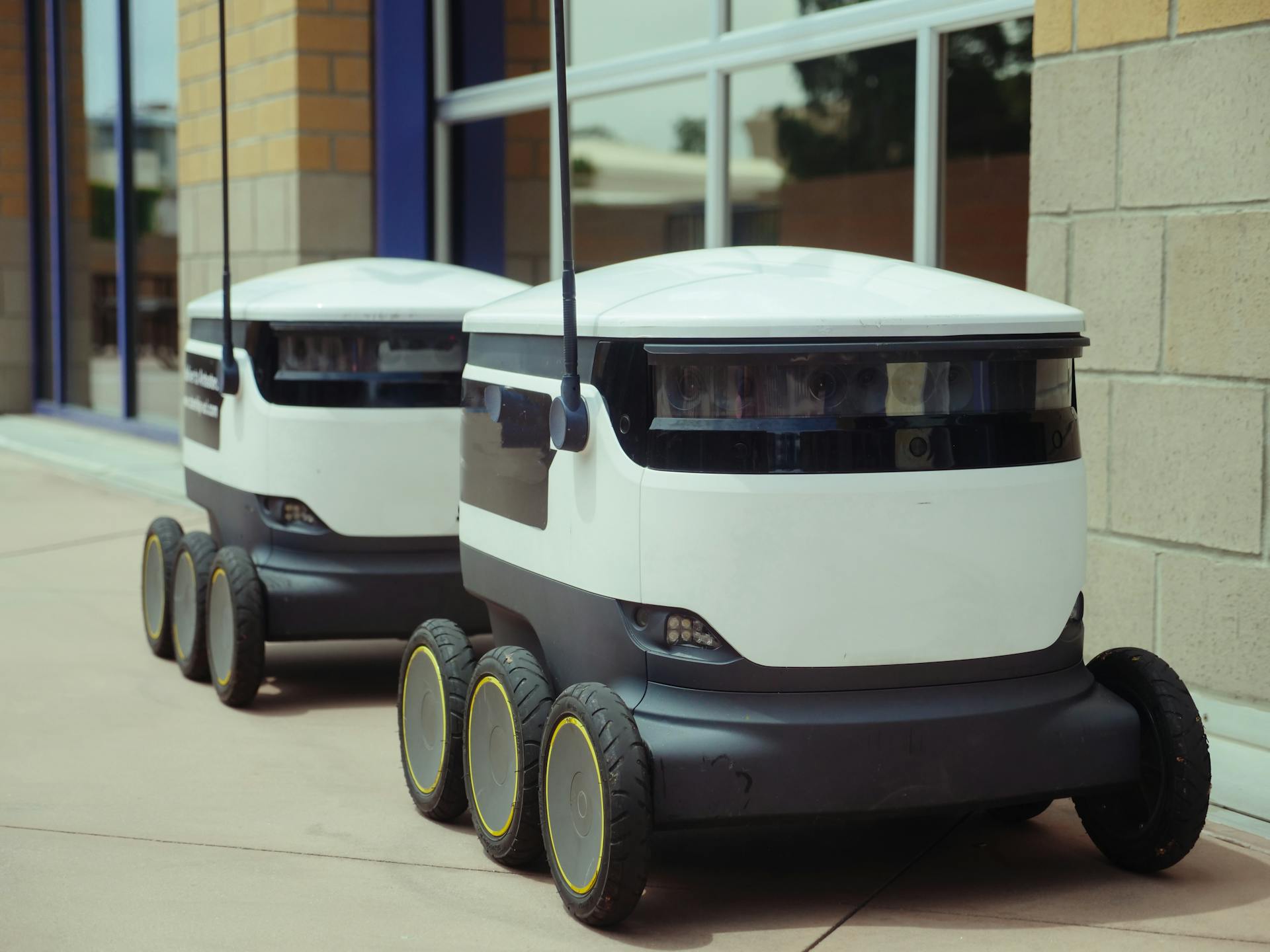
German Firms Push for Level 4 Logistics Shuttles
8 Min. reading time · As of: 23.04.2026
In April 2026, the Federal Highway Research Institute (BASt) adopted exemptions that explicitly permit autonomous Level 4 shuttles on company premises without a safety driver. Several DACH manufacturers and logistics operators have received pilot permits in recent weeks. What sounds like bureaucratic detail is the starting gun for a new generation of in-plant traffic in mid-sized production and intralogistics. The observation is worth it: it’s not long-distance traffic that will become autonomous in 2026, but the in-house shuttle circuit.
The Essentials at a Glance
- In April 2026, the BASt granted exception permits for Level 4 shuttle operations on private premises that do without a permanent safety driver.
- Initial pilot permits have been issued to manufacturers in Bavaria and Baden-Württemberg, as well as logistics operators in North Rhine-Westphalia.
- The focus is on company premises, logistics yards, and closed industrial parks, i.e., areas without public traffic and with clearly defined routes.
- Use cases: material transport between factory halls, pick-up and drop-off shifts between warehouse and production, personnel transport within large sites.
- Mid-sized manufacturers should review pilot applications in 2026, as the funding landscape is favorable and the approval practice is still learning.
What the BASt exemption regulation specifically allows
What is a Level 4 permit for factory premises? A Level 4 permit allows a vehicle to drive fully autonomously within a defined application area without a human driver taking responsibility. For factory premises, this means a clearly delimited Operating Design Domain, i.e., a specific area with fixed routes, speeds, and times of day, within which the vehicle can act independently. Outside this corridor, transfer regulations apply or the vehicle stops.
The Federal Highway Research Institute’s (BASt) exemption regulation from April 2026 is not the first attempt to make autonomous factory traffic legally secure. The German Autonomous Driving Act of 2021 created the framework, and the Autonomous Driving Ordinance of 2022 specified the requirements. What’s new in 2026 is the clarity for factory premises as the preferred Operating Design Domain. Previous permits often required a redundant safety driver setup, which undermined the economic benefits. The latest clarification provides a calculable basis.
The conditions are to be taken seriously. Pilot operators must present a technical safety concept that covers sensor technology, redundancies, fail-safe behavior, and cybersecurity aspects. They need an emergency shutdown chain that takes effect within seconds in an emergency. They must operate a control center that can monitor multiple shuttles simultaneously and react within clearly defined time windows in case of escalation. Those who meet these requirements receive a permit that is initially limited to 12 or 24 months and can be extended or expanded after evaluating the pilot phase.
Realistic Use Cases for Mid-Sized Companies Now
The exciting use cases for mid-sized manufacturers and logistics operators can be sorted into three categories. The first category is material transport within a multi-part plant complex. If you have component production in hall three and final assembly in hall seven, you currently regularly drive through the site with forklifts, route trains or forklift traffic. An autonomous shuttle reliably covers these routes, with higher repeat accuracy, lower personnel effort and a clearly documented process for audits and lean reviews.
The second category is the warehouse-production loop. Component supply from a central warehouse into several lines, combined with the return of empty containers. Autonomous shuttles are particularly well-suited here because the routes repeat and synchronization with the line cycles can be technically controlled. Process mining tools often provide the data basis to really understand the routes before the pilot start, rather than defining them on the fly.
The third category is personnel transport between plant gates, training centers, canteens and administrative buildings. On extensive sites, this is a significant comfort factor and contribution to recruiting. If you walk 800 meters to a meeting in a plant in pouring rain, you think differently about your employer than someone who can use a small shuttle. The numbers from the first pilot operations indicate that employee acceptance is very high after a short period of adjustment.
What Worksite Shuttles Can Already Do in 2026
- Drive defined routes with high repeat accuracy, even in rain, fog or snow
- Coexist with forklift traffic, pedestrians and stationary obstacles
- Automatically load and unload at transfer stations if the interfaces match
- Digitally record which routes were taken in what time, for audits and optimization
Where Caution is Still Advised in 2026
- Complex yard configurations with frequently changing obstacles require longer adjustment periods
- The interface to public transport remains strictly separated, requiring transfer regulations
- Cybersecurity requirements are high, operations control center must be redundantly designed
- Union topics such as job relocation must be addressed early and transparently
A Realistic 12-Month Path to a Productive Pilot
For those seriously considering whether an autonomous works shuttle fits their operations in 2026, a structured 12-month plan is essential. The phases can be implemented in any medium-sized production facility with an internal core team consisting of logistics management, plant engineering, IT, and works council.
How Autonomous Factory Shuttles Structurally Change the Economy
It’s worth taking a step back. Autonomous factory shuttles are not a premium toy, but a lever with three structural effects. Firstly, they relieve staff of repetitive transport tasks and enable them to be redeployed in higher-value activities. This is an answer to the ongoing shortage of skilled workers in production and the demographic development in logistics. Secondly, they create a data basis that is often missing today. Anyone who has digitally recorded every material transport can implement lean improvements, energy optimizations, and predictive maintenance concepts more precisely. Thirdly, they change the location discussion. A plant with functioning autonomous logistics is not only more efficient but also more attractive for investments, as expansions can be integrated more easily.
For management teams, an honest location assessment is worthwhile in the coming months. Which plants in the own group have route patterns suitable for autonomous shuttles? Which locations are politically suitable for a pilot, because works council and plant management are pulling together? Which customers in the own supply chain would react positively if plant logistics were upgraded? Which of them have been asking for this for a long time? The answers are rarely surprising, but rarely clearly formulated. A strategy session in May or June 2026 with this agenda is worthwhile, even if only a pilot in one plant starts at the end.
One last point needs to be on the table. Communication around autonomous shuttles in the plant is sensitive. If framed as cost-cutting, it risks an rejecting workforce. If introduced as a relief for existing teams, with clear promises for retraining and reskilling, acceptance is quickly gained. The first pilot operators report unanimously that the biggest hurdle was not technical, but lay in internal communication. Those who take up the lesson from two pilot years of pioneers save weeks of headwind and come to learning success faster, which paves the way for rollout in the corporation or group.
What suppliers and insurers need to do for the pilot launch in 2026
A successful pilot operation doesn’t just depend on your own in-house team. It relies on the ecosystem surrounding the provider. If you want to set up an autonomous works shuttle in Germany in 2026, you should seriously consider three external partners. First, the shuttle manufacturer itself, which not only supplies the vehicle but often also the operational model. Second, the TÜV or a comparable testing body that conducts the safety assessment and maintains certification. Third, the insurer that offers specialized packages for autonomous works traffic and works smoothly in the event of a claim.
These three partners should have at least three joint meetings during the preparation phase, with the plant management, IT security, and works council present. If you set this up in parallel with the decision-making phase, you won’t get any nasty surprises during the approval process. If you only start this after submitting the BASt application, you’ll lose weeks of renegotiations, which in the worst-case scenario could nibble away at the pilot’s time limit.
One point that is often underestimated is the interface with your own IT. Autonomous shuttles generate telemetry data that must be integrated into the existing MES, logistics platform, and cybersecurity monitoring. Whoever agrees on data sovereignty over usage data secures the basis for their own optimizations and negotiations during contract renewal. Whoever leaves the data to the provider gives up an important control lever.
Finally, cybersecurity should be on the agenda for the first workshops, not just before commissioning. An autonomous vehicle is a connected system with its own attack surface. Pen tests, secure software update processes, and a clearly regulated patch management are not options but obligations. If you address this early, you can score points with the BASt regarding the security concept and measurably improve your policy with insurers.
A final note from the first real pilot projects: the learning speed of your own operations teams in the plant is by far the greatest hidden success factor of any serious pilot phase. Plant managements that establish a disciplined weekly lessons-learned meeting in the operations calendar, where shift leaders, provider engineers, and IT control room staff jointly review data and incidents for two hours, build up a robust, internal control competence within half a year. This competence will become more important in the medium term than the choice of provider, as it makes the decisive difference between laborious pilot effort and a robust, economically viable regular operation in follow-up pilots and scaling.
Frequently Asked Questions
Which providers are approved in Germany by 2026?
The following providers are known: EasyMile, Navya, Sennder with its Shuttle subsidiary, ZF Mobility Solutions, Continental Engineering Services, and MOIA for person shuttles, as well as several specialized medium-sized companies from the AGV and FTS environment, such as SafeLog or Pepperl+Fuchs. Suitability depends heavily on the specific use case; no provider can do everything.
How do works shuttles differ from classic driverless transport systems?
Classic FTS move along predetermined paths, often with inductive tracks or magnetic strips. Autonomous shuttles drive along dynamically calculated routes, react to obstacles, and can interact with other road users. The sensor technology is significantly more extensive, and the range of applications is greater.
How long does a BASt approval take on average?
Initial experience from 2026 shows three to five months from a complete application to approval, depending on complexity and the provider’s level of experience. If you have an experienced provider familiar with the application process, you are on the lower end.
Which funding programs are relevant in 2026?
The Federal Ministry for Digital Affairs and Transport promotes autonomous driving through the federal-state initiative. In addition, industry 4.0 programs from states such as Bavaria, Baden-Württemberg, and North Rhine-Westphalia are available. Medium-sized digital centers often support the application and concept phase.
What does a productive works shuttle cost per year?
The total cost of ownership ranges from around 80,000 Euro per shuttle per year in a rental model to significantly higher six-figure amounts for in-house fleets with a control center setup. Scaling up from the second and third shuttle noticeably reduces unit costs.
How do insurance companies react to autonomous works shuttles?
Established insurers have developed special packages for autonomous factory traffic, combining liability, property, and cyber components. Premiums depend on the safety concept submitted with the application. If you discuss with the insurer early and in a structured manner, you avoid expensive renegotiations.
Read more on MyBusinessFuture
MyBusinessFutureProcess Mining in Medium-Sized Enterprises 2026: Celonis, SAP Signavio, and UiPath in UseMyBusinessFutureBosch: How AI Drives Zero-Defect Production in 50 PlantsMyBusinessFutureTrumpf Ditzingen: Smart Factory Increases Efficiency by 30%More from the MBF Media Network
cloudmagazinCloudmagazin: Mac Studio M5 for DevOps and Cloud WorkloadsDigital ChiefsDigital Chiefs: Managed Services in a C-Level Context 2026SecurityTodaySecurityToday: Security Data Fabric in the Mid-MarketSource of title image: Pexels / Kindel Media (px:8566538)
Translated from the German original using artificial intelligence. The German version is authoritative.

MyBusinessFuture / Evernine Media GmbH
Benedikt Langer befasst sich als Redakteur für MyBusinessFuture vor allem mit zukunftsweisenden Business- und Tech-Themen – von Künstlicher Intelligenz über Cybersecurity bis hin zu Mobilität, Energie- und Verkehrsinfrastruktur sowie resilienten Industrie-Ökosystemen.

