
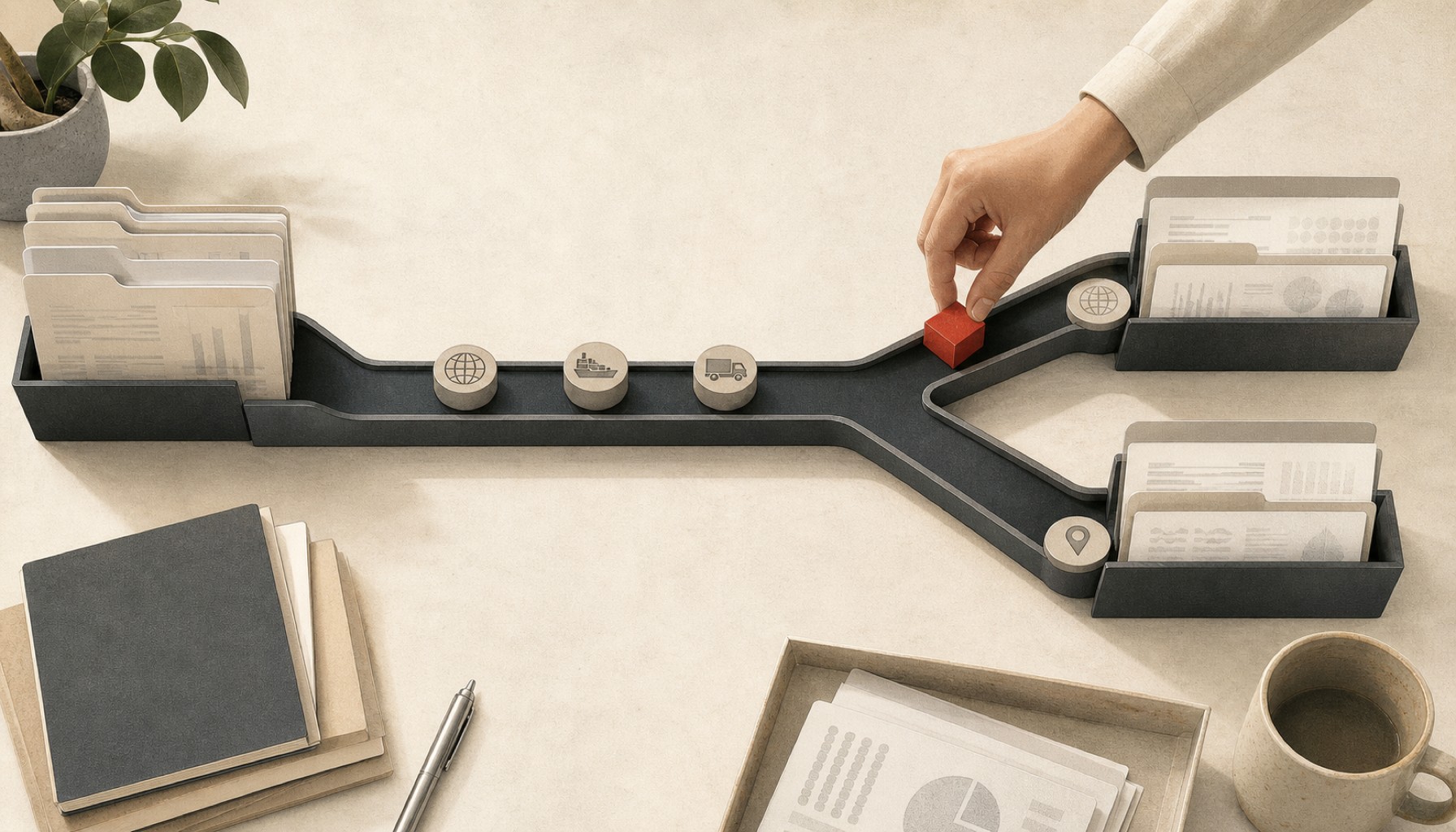
China+1 Strategy: When a Second Location Pays Off
6 min read
A second sourcing location outside China sounds like a corporate initiative. For a mid-sized company with a three-person purchasing team, it is simply a calculation: at what volume and under which tariff scenario does the more expensive second supplier recoup its premium? Anyone who skips this calculation decides from the gut-and the gut is almost always wrong on China+1.
Key Points at a Glance
- China+1 means adding, not replacing. The main supplier stays; a second location in Vietnam, India or Mexico is added alongside it. The annual category volume determines whether the move makes sense.
- Tied-up capital is the blind spot. Eight to twelve weeks of safety stock costs four to eight percent of the purchase value per year in inventory holding costs. This never appears on any freight invoice, yet it can flip the entire result.
- As a rule of thumb, the calculation turns at around two million euros. Below that threshold, setup costs eat up any labor savings. The popular small test order almost never pays for itself on its own.
RelatedAsia sourcing: what it really costs mid-sized companies / Nearshoring: risk or opportunity
I have been selling campaigns to mid-sized companies for years and hear the same sentence in every second conversation: we need to become less dependent on China. Then nothing usually happens, because nobody puts the numbers on the table. China+1 is a sober business case with five levers, not a question of worldview. Anyone who runs the numbers on each lever quickly sees whether the second location destroys margins or improves cash flow. These five points decide the outcome.
1. How Much Tariff Risk Is Really Embedded in Your China Volume
The first item is a bet on trade policy. Since October 2024, the EU has imposed additional countervailing duties of up to 35 percent on Chinese electric vehicles, which together with the base tariff effectively reach almost 45 percent. In addition, safeguard proceedings are running for steel and anti-dumping investigations for other goods. While most industrial components remain in the low single-digit range, the direction is clear. The real question is: What share of your procurement sits in categories that could face a tariff surcharge tomorrow.
This is where a location in a country with a free trade agreement pays off. Vietnam delivers zero percent tariffs on many industrial goods through the EVFTA (EU-Vietnam Free Trade Agreement), while the same goods from China carry two to eight percent, and more in strategic categories. This is no free pass for a complete relocation. It is an argument for placing the second site precisely on the tariff-exposed categories and keeping the rest in China.
2. The Tied-Up Capital No One Factors In
The most expensive item is also the most invisible. Anyone comparing only freight and customs overlooks the money sitting idle in containers and warehouses. A pure China route means 30 to 45 days of ocean transit plus buffer, often totaling eight to twelve weeks of safety stock. With inventory holding costs of 15 to 25 percent per year on the value of goods-covering interest, handling, shrinkage, and obsolescence-that quickly adds up to four to eight percent of the purchase price evaporating each year.
A second location with shorter or more stable routes reduces this buffer, because the risk of total failure is spread across two sources. Then there is the freight side: Since the rerouting around the Cape of Good Hope, container rates have remained significantly above pre-crisis levels, with surcharges of several hundred euros per container. Vietnam is often on par or slightly below in many cases, while Mexico and India are more expensive. The freight advantage alone rarely justifies the switch, but the combination of freight savings and freed-up capital does.
3. Why the First Twelve Months Erase the Labor Cost Advantage
Labor cost is the argument that launches every China+1 discussion. It is also the reason many projects ultimately fail. Yes, fully loaded manufacturing wages in Vietnam or India are often 40 to 60 percent of Chinese levels. For labor-intensive products such as assemblies, textiles, or simple mechanical parts, this creates a unit-price advantage of five to fifteen percent. For material-dominated products, the advantage shrinks to zero or turns negative.
The catch appears during the ramp-up phase. Initial production runs from a new country consistently show higher rework and scrap rates, often two to five times those of an established Chinese supplier. In the first six to twelve months, this ramp-up can wipe out an entire year’s labor cost savings. The economics usually turn positive only after the second audit cycle or once volumes are high enough to dilute the startup costs quickly.
| Cost Block | China-only | China+1 (Vietnam as Secondary Source) |
|---|---|---|
| Manufacturing Wage | Baseline | 40 to 60 % of China levels |
| EU Import Duty | 2 to 8 %, higher in special cases | often 0 % via EVFTA |
| Ocean Freight | Baseline (Red Sea surcharge) | on par to slightly cheaper |
| Safety Stock | 8 to 12 weeks | lower due to risk sharing |
| Ramp-up and Scrap | established, low | elevated for 6 to 12 months |
4. What Supplier Qualification Costs and When It Pays Off
Setting up a new supplier is project work with a real price tag. Audits, samples, trial runs, travel and the first series approvals realistically add up to 5.000 to over 25.000 euros per supplier for a mid-sized company, depending on the product and depth of testing. Added to this is the ongoing effort for dual operations: split orders, double quality monitoring and coordination add five to ten percent overhead.
These fixed costs are the reason volume decides everything. At an annual volume of under 500.000 to one million euros per category, the setup almost never pays for itself, no matter how low the wages are. The second location must recoup the initial investment within twelve to eighteen months; otherwise it remains an expensive safety net. This is exactly where a smaller player benefits: measure immediately whether the category can support the volume, instead of building a strategy slide deck.
5. The Tipping Point at Which the Second Location Becomes Worthwhile
All factors converge at one point. China+1 becomes more cost-effective overall than China-only when three conditions are met in the calculation: annual volume of around two million euros in the category, a labor share exceeding 25 to 30 percent, and a measurable disruption risk. Run a realistic scenario, such as a 30 percent tariff jump or a six-week blockage of the China route. The avoided risk expectation value often tips the balance on its own.
The most common mistake in thinking is the small test order. “Let’s just dip our toes in,” they say. This very test almost never pays off because it bears the fixed costs without delivering the volume that dilutes them. Anyone serious about China+1 shifts a relevant category with sufficient volume or skips it altogether. Sales provides an argument right away: A tariff-resilient secondary source is a selling point for customers with US business who themselves are asking for stable supply chains. This figure doesn’t appear in any freight table but still decides many a quote.
Frequently Asked Questions
Is China+1 the same as nearshoring?
No. Nearshoring refers to relocating production to a geographically close region, such as Eastern Europe or North Africa. China+1 means retaining China as the primary supplier while establishing a second location alongside it, often in Vietnam, India, or Mexico. The goal is risk diversification; the main supplier remains in place.
At what purchasing volume does a second location become worthwhile?
As a rule of thumb, setup costs rarely amortize below an annual volume of €500,000 to €1 million per category. The calculation turns positive at around €2 million, with a labor share above 25 percent and measurable disruption risk. Small test orders seldom cover fixed costs on their own.
Which hidden costs are most frequently overlooked?
Two main areas. First, capital tied up in safety stock, which costs four to eight percent of the purchase value per year on long China routes. Second, the quality ramp-up at the new supplier, which can erase the labor advantage in the first six to twelve months.
Does Vietnam really reduce tariffs compared with China?
For many industrial goods, yes. The EVFTA free-trade agreement lowers EU import tariffs for numerous categories to zero or significantly reduced rates, while the same goods from China face two to eight percent. The benefit is category-specific and should be verified per product.
Read more on MyBusinessFuture
MyBusinessFutureHow the Supply Chain Act Reaches German SMEsMyBusinessFutureEU-Mercosur Forces Supply Chains to Review ComplianceMyBusinessFutureLast-Mile Consolidation: Why Parcel Locker Networks Are MergingMore from the MBF Media Network
Digital ChiefsFive Points Where Supply-Chain Software BreakscloudmagazinSovereign Cloud Does Not End at the Server LocationSecurityTodayAn npm Package That Stole Private KeysImage source: AI-generated (July 2026)
Translated from the German original using artificial intelligence. The German version is authoritative.

