
When AI Capabilities Replace University Degrees
6 Min. read time
Nearly 3,000 companies, one uncomfortable figure: one in five believes it’s possible to replace university graduates with less qualified but AI-assisted employees. That’s the finding from the ifo survey in June. For SMEs, this shifts the question of what a CV even stands for anymore.
Key Takeaways
- 20 percent consider graduates replaceable: Roughly one in five AI-using companies believes university graduates can easily be replaced by AI-savvy workers with lower formal qualifications.
- Experience lasts longer: Only 15 percent see professional experience as easily replaceable. Learned routines are harder for AI to replicate than a formal degree.
- Industry makes the difference: In retail, 28.6 percent say easily replaceable; in construction, just 9.3 percent. Where work appears more standardised, companies place greater trust in AI.
- The leverage lies in recruitment: Those who still filter job candidates solely by degrees overlook AI-competent applicants without a traditional career path.
Related:AI Reskilling 2026: Three New Role Profiles / 13.3 million set to retire: The Boomer gap arrives
What the ifo figures really reveal
The ifo Institute surveyed nearly 3,000 companies in May, asking whether qualifications and professional experience could be replaced by artificial intelligence. The answer is more nuanced than the headline suggests. A minority sees the swap as feasible, while the majority remains sceptical. It’s this minority that sends the real signal.
What does replacing qualifications with AI actually mean? It means companies could cover part of the formal knowledge previously guaranteed by a university or vocational degree through AI tools and trained operational skills. The degree loses weight-without disappearing entirely-and the ability to confidently control AI moves up as a hiring criterion.
Around 20 percent of companies already using AI believe it’s easy or very easy to replace university graduates with non-specialist but AI-proficient workers. For professional experience, that figure is 15 percent. The gap is small, but it follows clear logic.
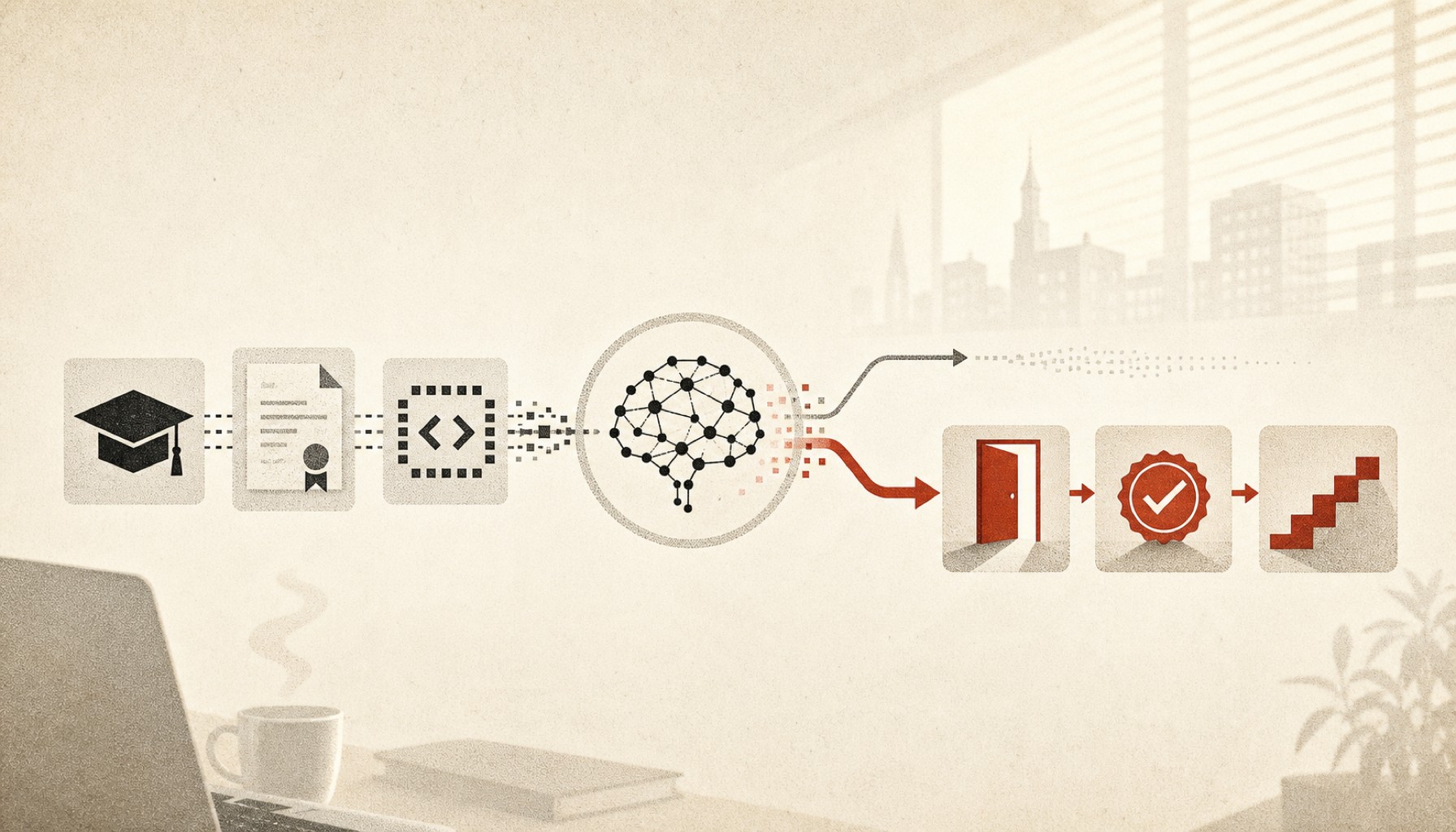
What’s crucial here is what the study doesn’t say. It measures companies’ perceptions, not actual layoffs. It shows a door opening-not one everyone has already walked through. That’s precisely why this minority deserves attention. The fact that one in five AI-using businesses considers swapping degrees for AI competence feasible is more telling than the reassuring majority behind it.
ifo survey, May 2026
Nearly 3,000 companies surveyed, across all industries.
20 percent of AI users see graduates as easily replaceable, 15 percent experienced professionals.
Majority remains cautious: Most still consider fully replacing degrees and experience difficult.
Where AI Replaces the Credential-and Where It Doesn’t
The impact isn’t evenly spread across the economy. In roles where tasks are highly standardized and well-documented, AI is trusted more. Where work depends on physical processes or hard-to-codify experience, it’s trusted less.
| Industry | Credential easily to very easily replaceable |
|---|---|
| Retail | 28.6 percent |
| Service providers | 19.7 percent |
| Manufacturing | 14.6 percent |
| Construction | 9.3 percent |
For mid-sized companies, this means the question isn’t whether AI replaces qualifications in general, but how standardizable your roles are. An administrative role in retail looks very different from a construction manager with twenty years of on-site intuition.
Why Experience Is Harder to Replace Than a Degree
A degree certifies knowledge that’s often already embedded in models and tools. Experience, on the other hand, is distilled pattern recognition from real-world cases-including mistakes no one documents. This kind of tacit knowledge doesn’t easily fit into a prompt.
This aligns with the ifo Institute’s findings: experience appears slightly harder for AI to compensate for than a formal credential. For workforce planning, that’s a crucial distinction. Entry-level roles with clearly defined tasks face pressure first, while experience-driven functions remain protected longer.
An everyday example makes the difference clear. AI can help a junior buyer compare offers and check contracts for standard clauses. But it can’t replace the instinct of a seasoned procurement manager who knows which supplier delivers under pressure-and which one just sounds good on paper. That knowledge isn’t in any dataset; it’s built from years of escalations. That’s why junior tasks with clear rulebooks shift to AI first, while hard-to-codify experience stays human.
What This Means for Recruiting in Mid-Sized Companies
Most job postings still filter first by degree and years of experience. But as AI skills gain value, this filter becomes a roadblock. In recruiting, that shifts several routines.
- The degree loses its must-have status. Someone who uses AI effectively and learns quickly can overcome a formal barrier that was once non-negotiable.
- Junior profiles become more hybrid. An entry-level employee with strong AI skills can take on tasks that previously required more experience.
- Experienced professionals gain value. Those who can interpret and correct AI outputs become the team’s quality control, ensuring the tool alone can’t deliver.
- Upskilling beats hiring. With talent in short supply, it’s often cheaper to train existing staff in AI than to wait for the perfect résumé.
How to Adapt Your Hiring Logic Now
Qualifications aren’t being devalued by the study-it simply highlights where the hiring framework can be usefully expanded. Three steps work immediately, without requiring a new budget.
First, include AI proficiency as a distinct criterion in job postings, backed by a concrete task in the selection process. Second, for junior roles, lower the formal minimum requirements and replace them with a short practical test. Third, train your existing team so experienced staff can confidently guide AI tools.
SMEs even have an advantage here. Short decision-making paths allow them to assess candidates based on real tasks, not just certificates. Those who leverage this find talent that large corporations with rigid requirement profiles might overlook.
One limit remains: today’s AI skills can’t replace tomorrow’s judgment. If you only optimize for tool proficiency, you’ll build a team that delivers results quickly but fails to question them critically. The smarter take on the ifo data is this: keep formal foundations where they matter, and foster AI skills wherever speed counts. Those who combine both gain velocity and reliability in one.
Frequently Asked Questions
What exactly did the ifo study examine?
In May 2026, the ifo Institute surveyed nearly 3,000 companies to determine whether formal qualifications and professional experience could be replaced by artificial intelligence. The study captured insights across industries and company sizes.
Is AI replacing university degrees now?
No, at least not across the board. Around 20 percent of companies using AI believe it’s relatively easy to replace university graduates with AI-supported, less formally qualified staff. The majority still see this as challenging.
Which industries are most affected?
The highest share is in retail at 28.6 percent, followed by services at 19.7 percent and manufacturing at 14.6 percent. Construction lags at 9.3 percent, where work is naturally harder to standardize.
What does this mean for SME training?
Upskilling becomes even more critical. With skilled labor in short supply, it’s often more cost-effective to make existing employees AI-proficient than to wait for the perfect résumé. Experienced staff then act as gatekeepers for AI-generated outputs.
Should SMEs change their job ads?
Yes, to a degree. It makes sense to list AI proficiency as a separate criterion and lower formal entry barriers for junior roles-perhaps in favor of a short practical test. Degrees still matter, but they’re no longer the only gateway.
Editor’s Picks
- The Cost of an Unfilled Position for SMEs
- 54.5 Percent Use AI-Yet SMEs Still Lag Behind
- AI’s Social License: When Adoption Outpaces Trust
Read more on MyBusinessFuture
MyBusinessFuture13.3 million people retire: The baby boomer gap arrivesMyBusinessFutureNinety-five percent of AI pilots yield nothing, five percent doMyBusinessFutureIncreasing the value of a company before succession with AIMore from the MBF Media Network
cloudmagazinDeutschland-Stack Goes Live: 250 Million Euros for the Federal AI CloudDigital ChiefsAI Broke Hiring-What Matters NowSecurityTodayZombie Accounts: The IAM Blind Spot in OffboardingImage source: AI-generated (Juni 2026)
Translated from the German original using artificial intelligence. The German version is authoritative.

