

The Cost of an Unfilled Position to Small and Medium-Sized Businesses
6 min read
In Germany, a qualified position remains vacant for an average of around 173 days-almost half a year. Stepstone has calculated the cost of such a gap in a model: around €49,500 per unfilled role, driven by lost productivity, extra workload for the team, and missed contracts. For a mid-sized company with multiple open positions, this figure appears directly on the balance sheet.
Key Takeaways
- The gap comes with a price tag. An open position costs an average of €49,500, with the vacancy period lasting 173 days. According to the IW Köln, the shortage costs the economy around €49 billion per year.
- The mid-sized sector can’t win on salary. Large corporations lead the race for the highest wages. The mid-sized sector’s levers are speed, flexibility, retention, and an honest employer brand.
- Recruiting is a process, not a job ad. Those who treat the role like a campaign-with a clear profile, fast feedback, and nurtured relationships-close the gap sooner and more cost-effectively.
Related:Process optimization without the endless project / Why AI fails in mid-sized companies-by design
What an open position really costs
What is the skilled labor shortage? The skilled labor shortage describes the situation where companies cannot fill open positions with suitably qualified applicants. It is not a short-term bottleneck but a structural consequence of demographics. According to the DIHK Skilled Labor Report 2025/2026, 36 percent of companies report difficulties filling positions.
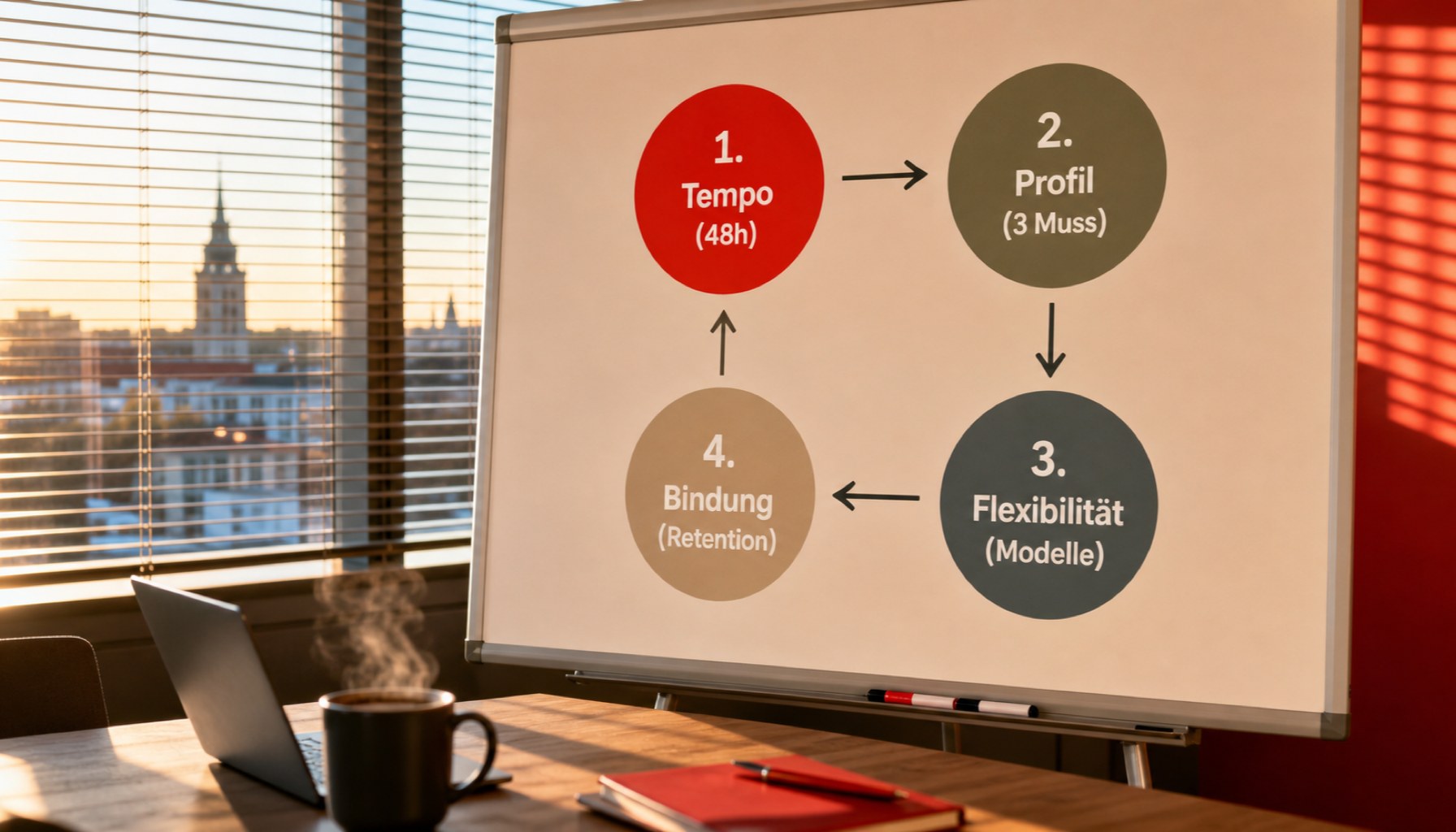
The costs of an open position often remain invisible because they don’t appear on any invoice. They hide in overtime for the existing team, in orders that aren’t accepted, and in projects that get delayed. Stepstone has modeled this: €49,500 per unfilled role. The longer the search drags on, the larger this figure grows-and with an average vacancy period of around 173 days, the search is rarely quick.
The economic impact adds up. The Institute of German Economics estimates lost production potential due to the skilled labor shortage at around €49 billion per year, with an upward trend. For the individual mid-sized company, the message is simpler: every month a key position stays vacant costs more than most measures to shorten the search.
Why mid-sized companies lose the salary race
If a small business tries to outbid large employers on salary, it has already lost. A corporation can set a starting salary that would eat into a mid-sized company’s margins. Don’t even enter that race.
Here’s the thing: candidates rarely decide on salary alone. What a small business can offer is precisely what’s often missing at big companies-visible responsibility from day one, short decision paths, a role with tangible impact, and a boss who knows your name. These arguments cost no extra budget; they just need to be communicated honestly and then delivered.
The founder’s perspective helps here. The strength of a small player lies in focus. Targeting 50 suitable candidates directly gives an edge over blasting an anonymous ad to 5,000 and hoping for responses. Recruiting works like a well-built campaign, not a notice on a bulletin board.
Four levers without corporate budgets
Real-world experience reveals four levers that don’t touch salaries yet still cut time-to-fill significantly.
Retention beats re-hiring every time
The final lever deserves its own spotlight because it’s so often overlooked. Every prevented resignation spares the business the average cost-and the long vacancy-that a replacement inevitably brings. Retention is therefore the most direct brake on spending a mid-size employer can pull, and it’s not some soft HR sideshow.
What binds people is rarely headline-grabbing. It’s regular conversations where real development happens, fair recognition of extra effort, and the assurance that good work doesn’t vanish into the void. Here small firms hold an edge-if they seize it: lines of communication are short, the boss is accessible, and a genuine “thank you” carries more weight than any corporate program.
The skills shortage won’t disappear-its roots are too deep. Yet what was once a market problem becomes a set of dials the company itself can turn. That’s the difference between complaining about the market and taking action inside your own four walls.
Frequently Asked Questions
What does an unfilled position really cost?
According to a Stepstone model calculation, each unfilled position costs an average of around €49,500. These costs arise from lost productivity, increased workload for the existing team, and missed business opportunities. With an average vacancy period of 173 days, this expense runs for about half a year.
How can a small business compete with corporations for skilled workers?
Not through salary, but through speed, flexibility, and visible responsibility. Short decision-making processes, quick feedback during recruitment, and roles with clear impact are arguments that are often missing in large corporations-and they don’t require extra budget.
Why does filling skilled positions take so long?
The average vacancy period has risen to 173 days, and in sectors like construction, it’s even longer. The root cause is a structural shortage of suitably qualified applicants. Slow, cumbersome recruitment processes further extend the timeline, as strong candidates often accept other offers in the meantime.
Is employee retention more worthwhile than recruiting?
In most cases, yes. Every avoided resignation saves the business the full cost and vacancy period of a replacement. Investments in development, fair working conditions, and regular feedback are usually cheaper than searching for replacements-and they take effect immediately.
How large is the skilled labor gap in Germany?
The Institute of German Economics estimates the skilled labor gap at around 573,000 positions and projects it could grow to about 768,000 unfillable roles by 2028. The DIHK Skilled Labor Report 2025/2026 confirms: these shortages remain an ongoing challenge.
Editor’s Picks
- AI as a Turnaround Lever: Four SMEs Show How It Works
- Digital Procurement: Boosting Efficiency in SMEs
- The Partnership That Delivers More Than Any Acquisition
Read more on MyBusinessFuture
MyBusinessFutureWhen the Life’s Work Finds No SuccessorMyBusinessFutureChange Fatigue in Small and Medium-Sized Enterprises: Leadership as RoutineMyBusinessFutureCrisis Management Plan Over Crisis PR: Four Key Decisions for Small and Medium-Sized EnterprisesMore from the MBF Media Network
Digital ChiefsCEO Burnout: Mental Health at the Leadership LevelcloudmagazinAI Is No Longer a Playground for the IT ChannelSecurityTodayWhere SMEs Still Lag Behind on NIS2 Technical RequirementsImage source: Cover and article images AI-generated (May 2026), C2PA certificate embedded in images
Translated from the German original using artificial intelligence. The German version is authoritative.

