

When the Life’s Work Finds No Successor
6 Min. read time
According to KfW, the average age of business owners handing over their companies is 65.4 years, and the baby boomer generation is now stepping back. Around 109,000 small and medium-sized enterprises aim for succession each year until 2029. At the same time, roughly 114,000 businesses annually face closure without a successor-often healthy companies simply lacking an heir.
Key Takeaways
- The succession wave is here. Around 109,000 mid-sized companies seek succession annually, with owners averaging 65.4 years. The bottleneck is demographic and growing.
- Preparation beats sales skills. Most transitions fail due to lack of early planning, unrealistic price expectations, and knowledge locked in the owner’s head.
- Early planners have more options. Five to seven years of lead time open doors to family solutions, sales, management buyouts, or foundations. Those who wait risk closure.
Related:The partnership that carries more weight than any takeover / Process optimization without endless projects
Why the succession gap is widening now
What is business succession? Business succession refers to the transfer of leadership and ownership of a company to a successor. This can happen within the family, to employees, external buyers, or via a foundation. For SMEs, it’s rarely a single event but a process spanning several years.
The figures from KfW’s Succession Monitoring report in January 2026 are clear. An entire generation of entrepreneurs is reaching retirement age simultaneously. Meanwhile, the next generation is smaller in number and less likely to take over a family-run business. Supply and demand are diverging demographically.
The result is a wave of closures already underway. When a healthy business shuts down for lack of a successor, jobs, supplier relationships, and decades of accumulated knowledge vanish. For the owner, it also means the retirement savings tied up in the company won’t translate into sale proceeds.
Why SME Handovers Fail
Anyone who has witnessed handovers up close rarely sees a buyer problem. Instead, they see three persistent patterns.
The price expectation doesn’t match the market. According to KfW, owners planning to hand over their business within five years expect an average of 499,000 euros-up from 372,000 euros six years ago. Expectations are rising while the pool of buyers shrinks. A business priced above its realistic earnings value will stall.
The knowledge isn’t transferable. In many SMEs, the critical details live in the owner’s head: client relationships, supplier terms, the unwritten rules of daily operations. If none of this is documented, a successor buys a black box-one whose value drops the moment the owner leaves.
The family solution is taken for granted for too long. Many owners quietly assume their children will take over, never discussing it openly. If the next generation declines, the search for an alternative often begins in the owner’s mid-sixties-leaving too little time for a smooth handover.
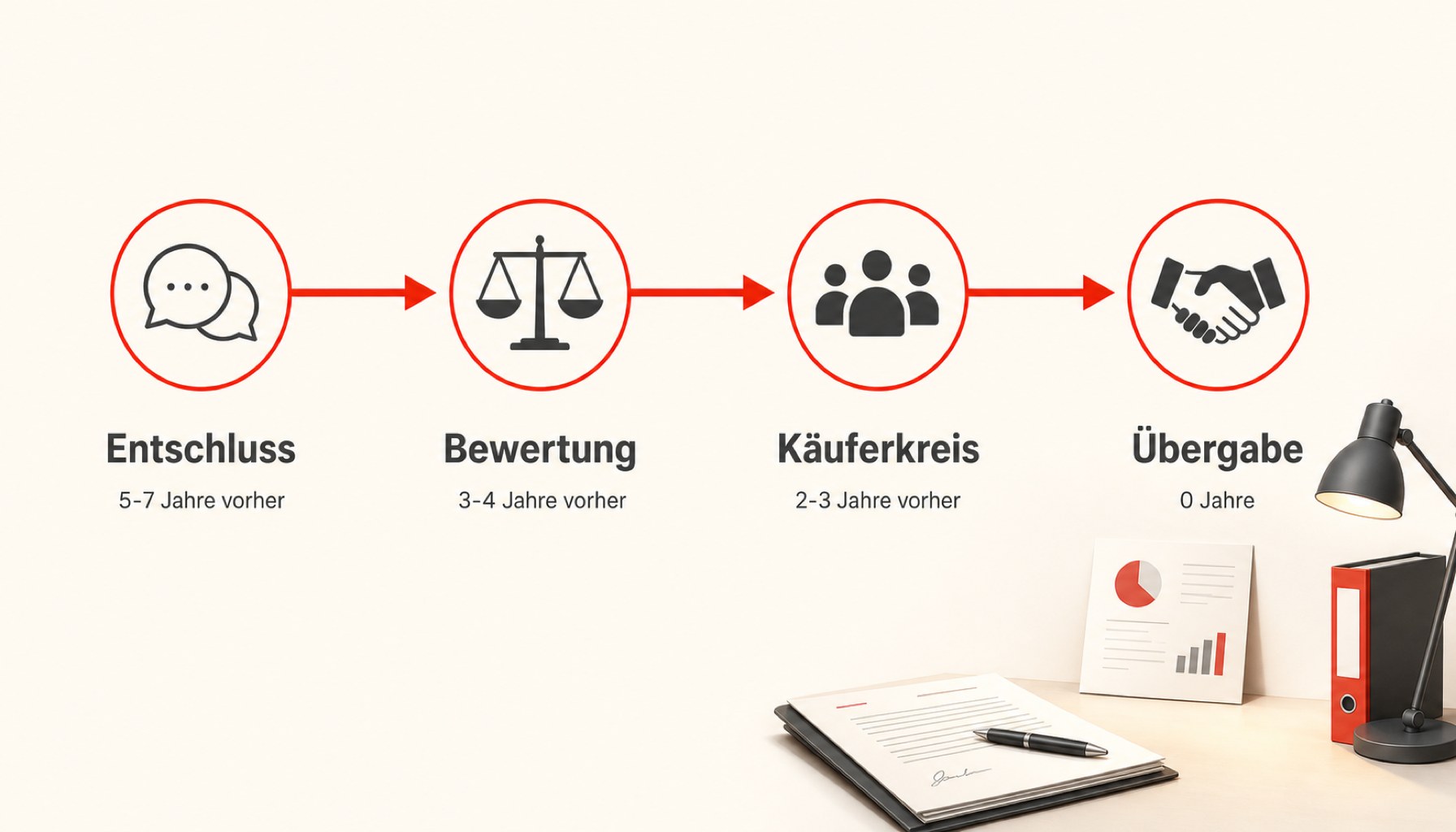
The Succession Roadmap: Five to Seven Years
A handover doesn’t succeed in the year of exit-it succeeds in the years leading up to it. The following timeline is deliberately long-term, because every step needs lead time.
Those who tackle succession only in their exit year negotiate from a position of weakness-and in the worst case, end up in the statistics of 114,000 business closures. Those who treat it as a multi-year project retain control over their exit and the value it holds.
Frequently Asked Questions
How far in advance should succession planning begin?
Five to seven years before the planned exit. This timeframe is needed to resolve family matters, conduct a realistic valuation, explore multiple buyer options, and train the successor. Those who start only in their mid-sixties lose negotiating leverage and risk closure.
Why do so many businesses struggle to find a successor?
The primary reason is demographic: the outgoing generation is large, while the incoming one is smaller and less willing to take over a family-run business. Additionally, unrealistic price expectations and knowledge that exists only in the owner’s head-making it impossible to transfer-often play a role.
What succession options exist beyond passing the business to family?
Beyond keeping it in the family, options include a management buy-out by existing executives, selling to an external buyer or strategic partner, or establishing a foundation. Keeping multiple paths open ensures you’re not dependent on a single commitment and strengthens your negotiating position.
How is a mid-sized business realistically valued?
In practice, valuation is based on sustainable earnings-what the business can reliably generate over time-not the owner’s desired price. The gap is often wide: while seller expectations, according to KfW, have risen to 499,000 Euro, the pool of willing buyers is shrinking.
What happens to company knowledge during the handover?
It must be made transferable-or the business loses value when the owner leaves. Customer relationships, supplier terms, and day-to-day operations need to be documented and passed on during a structured transition. A black box is hard to sell.
Editor’s Picks
- AI as a Turnaround Lever: Four Mid-sized Companies Show How It Works
- Digital Procurement: Boosting Efficiency in Mid-sized Businesses
- Cloud vs. On-Prem: What Matters Financially
Read more on MyBusinessFuture
MyBusinessFutureChange Fatigue in Small and Medium-Sized Enterprises: Leadership as RoutineMyBusinessFutureCrisis Management Plan Over Crisis PR: Four Key Decisions for Small and Medium-Sized EnterprisesMyBusinessFutureEU Hydrogen Bank: 1.3 billion change the distributionMore from the MBF Media Network
Digital ChiefsCEO Burnout: Mental Health at the Leadership LevelcloudmagazinAI Is No Longer a Playground for the IT ChannelSecurityTodayWhere Mid-sized Businesses Lag Behind on NIS2 Technical RequirementsImage source: Cover and article images AI-generated (May 2026), C2PA certificate embedded
Translated from the German original using artificial intelligence. The German version is authoritative.


