
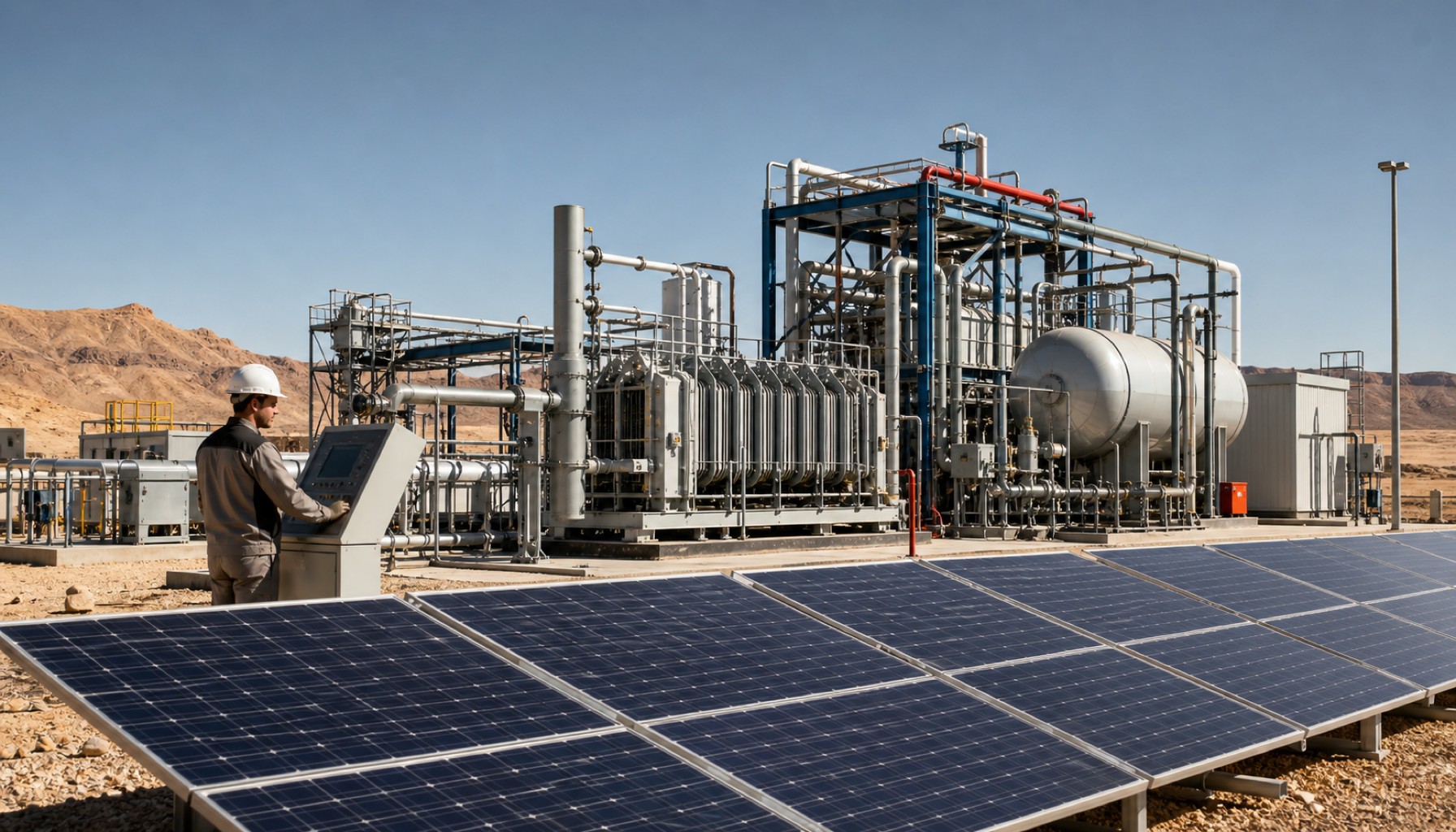
Desertec Reloaded: What Desert Power Means for Energy Costs
7 min. read
Ten years ago, the idea of powering Europe with electricity from the Sahara was considered dead. Now Desertec is back – this time with green hydrogen instead of power cables. For energy-intensive mid-sized companies, that sounds like an answer to soaring energy costs. What the plan actually delivers hinges on questions nobody has answered yet.
Key Takeaways
- New attempt, new product: The stalled electricity dream has become Desertec 3.0 – a plan for green hydrogen from the deserts of North Africa and the Middle East.
- Many partners, missing pieces: The MENA Hydrogen Alliance claims more than a hundred partners. Pipelines, financing, and a coherent political strategy are still absent.
- No quick fix for mid-sized businesses: Affordable desert hydrogen could ease energy costs in the long run. Until then, power purchase agreements remain the more realistic option.
Related:EU Hydrogen Bank: €1.3 Billion reshapes the market / Clean Industrial Deal: Mid-sized companies in focus
From a failed power dream to a hydrogen plan
What is Desertec? Desertec is an initiative originally launched in 2009 that set out to harvest solar and wind power from the deserts of North Africa and the Middle East – initially for export to Europe. The first consortium largely dissolved within a few years. The idea itself survived and has since reinvented itself more than once.
That first attempt collapsed under the weight of funding shortfalls, geopolitics, and the sheer logistical challenge of moving electricity thousands of kilometres to Europe. What had been announced as a once-in-a-century project ground to a halt. That backstory matters for the current push, because many of the old obstacles have not gone away.
Today the focus has shifted to green hydrogen. Rather than exporting electricity directly, the plan is to use renewable energy in sun-rich regions to produce hydrogen – a fuel that can be stored and traded over long distances, albeit with its own conversion losses. European demand is real: carbon-neutral energy carriers are urgently needed by industry.
What Desertec 3.0 actually looks like today
The new push is driven by Dii Desert Energy and the MENA Hydrogen Alliance it founded. The goal is a regional partnership between Europe, North Africa, and the Middle East that builds local value chains around green hydrogen – not merely an export corridor pointing north.
According to project figures, the Alliance has brought more than a hundred partners on board, including major names from the energy and industrial sectors. Reports indicate that players such as Siemens Energy and Linde are involved, alongside companies from North Africa and the Gulf region. That is a considerably broader foundation than the first attempt, which leaned heavily on a handful of large corporations.
What this could mean for energy-intensive mid-sized businesses
For a mid-sized manufacturing company with high energy costs, the critical question is less about the vision than the timeline. Nobody is going to be delivering desert hydrogen directly to industrial estates any time soon. The realistic benefits are medium- to long-term and run through two channels.
The first is cheaper green hydrogen as an energy carrier for processes that cannot easily be electrified, such as high-temperature heat. If costs fall here, it will meaningfully ease the burden on energy-intensive industries. The second is long-term electricity supply contracts – known as PPAs (power purchase agreements) – through which companies can already lock in generation from renewable sources at predictable prices. This route is open today, regardless of whether Desertec 3.0 achieves its grand ambition.
The case for it
- Broad partner base spanning energy and industry
- Hydrogen can be stored and traded
- Europe is actively seeking climate-neutral energy carriers
- PPAs available now as a near-term interim step
What remains unresolved
- Pipelines and transport infrastructure are missing
- Financing at the billion-euro scale remains unclear
- Political strategy is still incomplete
- Long lead times before the first delivery
What still needs to happen before the first delivery
The open questions are not matters of detail. The pipelines and transport routes needed to bring hydrogen to Europe at all simply do not exist yet. Add to that unresolved financing for projects of this scale, and a political strategy that would make offtake and pricing reliable enough to attract investors.
For decision-makers in mid-sized businesses, the takeaway is to read Desertec 3.0 as a signal, not a solution for the next fiscal year. Anyone looking to cut energy costs today should focus on efficiency, on-site generation, and supply contracts. Anyone thinking strategically should keep an eye on the hydrogen corridors – without staking plans on a timeline that nobody can yet guarantee.
Frequently Asked Questions
Hasn’t Desertec already failed?
The first attempt, launched in 2009, never reached its original goal, and the consortium largely dissolved. The idea, however, was relaunched. Desertec 3.0 now focuses on green hydrogen rather than direct electricity exports to Europe.
Why hydrogen instead of electricity now?
Transporting electricity across thousands of kilometres is expensive and lossy. Green hydrogen can be stored and traded – even if conversion losses apply. Europe also needs climate-neutral energy carriers for processes that cannot simply be electrified, such as heavy industry.
Can my mid-sized business benefit from this today?
Not directly yet. Desert hydrogen is not available for widespread use. The lever available right now is long-term power purchase agreements from renewable sources, which allow businesses to lock in predictable prices – independent of the project’s progress.
What are the biggest risks facing the project?
Missing transport infrastructure, unresolved financing on a billion-euro scale, and an incomplete political strategy. These three factors will determine whether the vision translates into reliable supply chains – or whether the project stalls once again.
How should a decision-maker approach this topic?
Treat it as a strategic signal, not a planning basis for the coming year. Near-term energy costs are best reduced through efficiency measures, on-site generation, and supply contracts. The hydrogen corridors belong on the long-term radar – without committing to any fixed timeline.
Editor’s Reading Picks
Read more on MyBusinessFuture
MyBusinessFutureEU Hydrogen Bank: 1.3 billion change the distributionMyBusinessFutureCircular Economy Becomes MandatoryMyBusinessFutureIFAT: Clean Industrial Deal Impacts SMEs from 2027More from the MBF Media Network
cloudmagazinCoolify Reviewed: Self-Hosting Instead of Vercel and HerokuDigital ChiefsThe Operating Model That Survives the ReorgSecurityTodayPasskeys in the Mittelstand: The End of the PasswordImage source: AI-generated (June 2026), C2PA certificate embedded in image
Translated from the German original using artificial intelligence. The German version is authoritative.

