
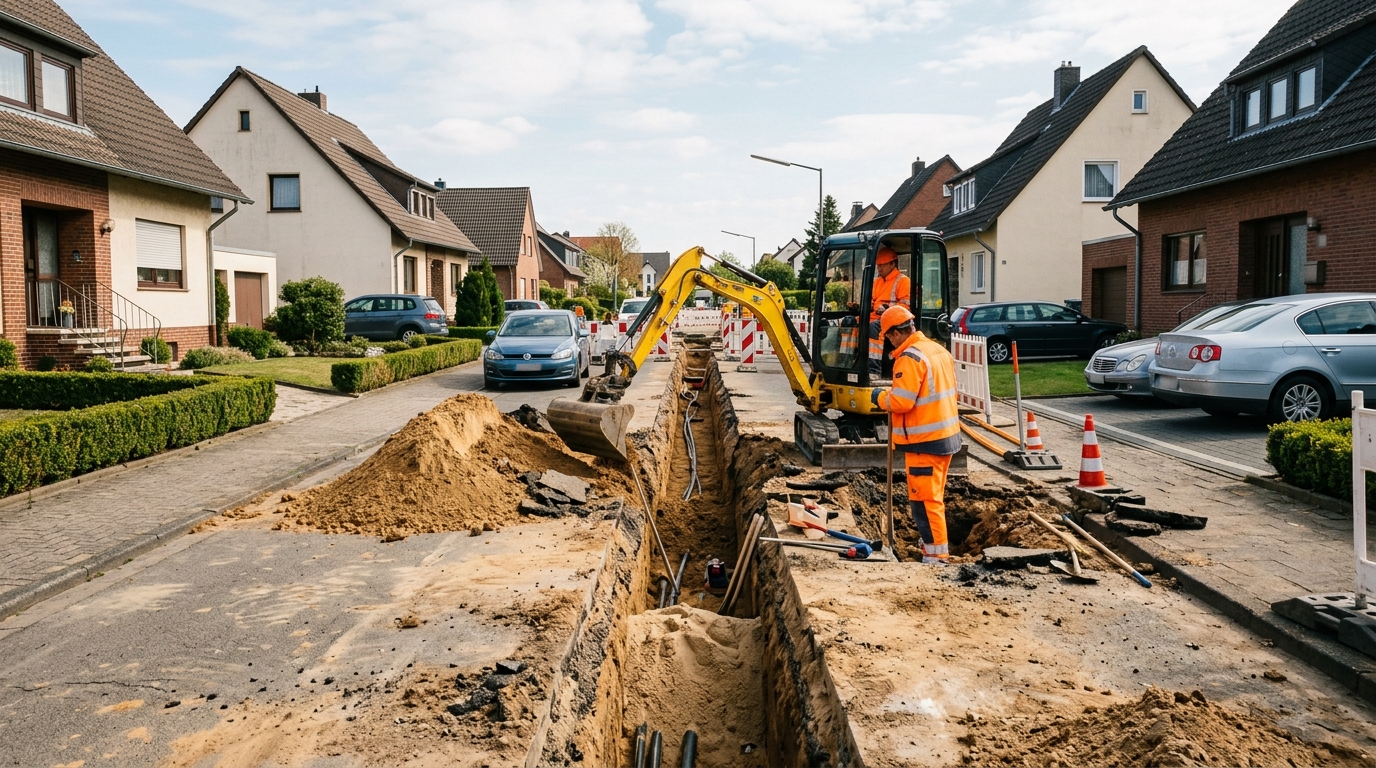
TKG Amendment: New Access Rules Change Fiber Investments
8 Min. Reading Time · As of: 23.04.2026
In spring 2026, the regulatory framework for fiber optic expansion in Germany is being reorganized. The Federal Ministry for Digital and State Modernization has presented the draft bill for the 2026 TKG amendment. The Federal Network Agency is working in parallel on a migration strategy for copper switch-off. In addition, there is the adaptation to the EU Gigabit Infrastructure Regulation 2024/1309. For German SMEs, this means a significant change: fiber optic investments in commercial parks, industrial sites, and office corridors will have a new set of rules in 2026.
Key Takeaways
- The 2026 TKG draft bill creates a separate access regime for non-subsidized fiber optic networks at network level 3 with § 22a.
- The Gigabit Infrastructure Regulation 2024/1309 is being transposed into German law, and road law approval procedures are being accelerated.
- The Gigabit Land Register is being legally established as a central data hub and will be a mandatory tool for location decisions in 2026.
- The BNetzA is working on a migration path that can trigger copper switch-off from an FTTH coverage of 80 percent, also by providers other than Telekom.
- Mid-sized investors in commercial parks gain open-access leverage, but should secure the new access rules with concrete contracts in 2026.
What changes specifically in the TKG and why it affects mid-sized businesses
What is the 2026 TKG amendment? The 2026 TKG amendment is a draft bill on the Telecommunications Act presented by the Federal Ministry for Digital and Structural Transformation in spring 2026. It adapts German law to EU Regulation 2024/1309 on Gigabit infrastructure, accelerates approval procedures for fiber-optic and mobile network expansion, legally anchors the Gigabit land register, and introduces new access regulations, such as § 22a TKG-E for non-subsidized fiber-optic networks in areas with only one network operator. It is currently undergoing consultation with associations and federal states.
The amendment is not a one-off intervention but a fundamental reordering of the next decade of fiber-optic investment. Three main directions can be identified. Firstly: acceleration. Approval procedures for underground construction and laying cables are streamlined, and a new notification procedure partially replaces the classic approval process. Secondly: data clarity. The Gigabit land register becomes a binding map recording networks, availability, and expansion plans. Investors now have a reliable nationwide view of infrastructure for the first time. Thirdly: access rules. § 22a TKG-E forces network operators in monopoly areas to adopt open-access conditions, giving the Federal Network Agency (BNetzA) wide scope for design.
For mid-sized businesses in industry, logistics, and commercial centers, this mix is relevant because it makes location decisions more transparent. Those planning connections for a new hall, logistics center, or commercial park previously often negotiated with different carriers for months. With the Gigabit land register and § 22a, the map becomes clearer, and the negotiating position improves. Those who experienced connection problems in the last two years should check in 2026 whether the new legal situation brings better conditions or new providers into play.
Which Use Cases Will Benefit in the Mid-Market by 2026
Four application classes will benefit noticeably. The first is site development. Those planning an industrial area or digitizing an existing business park can tender with multiple carriers in parallel and compare conditions by 2026, as the gigabit land register provides transparency on the initial situation. For non-subsidized routes, § 22a facilitates the shared use of passive infrastructure, reducing the duplication of empty ducts. As a result, site development becomes more cost-effective.
The second class is the migration from old connections. Those still using DSL connections in branches, subsidiaries, or backup paths should plan the transition to newer technologies in a structured manner by 2026. The BNetzA strategy for copper switch-off varies by region, but an FTTH quota of 80 percent in a development region can now be driven by carriers other than Deutsche Telekom. Branches in regions with high fiber coverage must prepare for the switch in the short term; otherwise, they risk being left without a connection.
The third class is the multiple connectivity of critical sites. Logistics hubs, cloud-on-premise setups, and smart factory locations require redundant connections with different routes. Open access to NE3 facilitates multiple carrier assignments, as a single physical network is open to multiple providers. As a result, resilience becomes not only more expensive but also realistically achievable. A site operator can conclude two contracts with different carriers, both of which are based on the same fiber network but offer different SLAs and routing.
The fourth class is Data Act-compliant IoT connectivity. Industrial sensors, logistics tracking, and energy management require reliable, low-latency connections with transparent data residency. Fiber islands in business parks form the basis for this. Those planning an IoT rollout for 2027 should prioritize the connectivity question before investing in sensors, as delivery times for connections vary by region.
What Mid-Market Companies Can Leverage in 2026
- Gigabit land register as a reliable map for site decisions
- Open access conditions for non-subsidized fiber networks in monopoly areas
- Accelerated road law approvals for own civil engineering work
- Multi-carrier constellations over a single physical network for resilience
What Risks Remain
- BNetzA general decrees can unilaterally set conditions; contracts must take this into account
- Copper switch-off will severely impact branches without a migration plan
- Open access does not automatically mean lower prices, but rather negotiable conditions
- Monopoly areas remain monopoly areas if no competitors consider entering the market
“For the German mid-market, this represents a significant change: fiber investments in business parks, industrial sites, and office corridors will have a new playbook by 2026.”
A Practical 12-Month Roadmap for IT and Site Managers
To get a clean start in 2026, work along a clear 12-month roadmap. The plan covers inventory, contract analysis, negotiation, and migration. It is suitable for medium-sized industrial companies, logistics operators, and site developers.
What the amendment structurally means for site development and management
The TKG amendment and its adaptation to EU requirements are not just a tech issue, but a location issue. Anyone investing in logistics, production, or office clusters in 2026 will suddenly have a different negotiating basis with municipalities, carriers, and builders. The discussion about fiber-optic connections must be included early in construction planning, rental agreements, and funding applications. Anyone writing a location concept without a connection strategy is making assumptions that will shift noticeably by 2027.
For management, there is a second lever. Multi-year carrier contracts with non-updated migration clauses will become a potential trap in 2026. Anyone who signed a 5-year DSL-based contract in 2024 must check in 2026 whether the migration option to fiber-optic is included in the contract or whether renegotiation is necessary. The regional effects of the BNetzA copper switch-off triggers vary by federal state, so a nationwide location inventory is less of an end in itself than a management tool.
For medium-sized investors in commercial parks and industrial areas, the amendment opens up new scope. Open access to non-subsidized fiber-optic networks allows building one’s own FTTB infrastructure and opening it up to multiple carriers for marketing. This noticeably changes the economic viability calculation for owners of commercial properties. Those who previously waited two or three years for a carrier can make their location more attractive with their own fiber-optic island in 2026 and simultaneously amortize investments over several rental cycles.
An additional strategic factor is the Reboot Germany funding that will flow into infrastructure and location development in 2026. Anyone conducting funding eligibility checks and economic viability analyses should incorporate the regulatory changes into their argumentation. Funding approvals are granted more quickly when locations with transparent connection strategies and comprehensible migration planning are applied for. Those who do not do this systematically will miss out on funding quotas.
One final observation belongs on the management agenda. The shortage of skilled workers in fiber-optic construction will continue to be a bottleneck in 2026. Even accelerated approval procedures are of little help if construction teams are not available. Those who conclude framework agreements with civil engineering partners and fiber-optic specialists early on will secure delivery slots that will remain scarce over the next two years. Medium-sized companies that underpin their location planning with concrete construction slots will be able to achieve productive connectivity faster in 2027 than competitors who are still stuck in approval loops.
How fiber optic strategy is intertwined with other regulatory topics
Fiber optic topics rarely stand alone in 2026. They are intertwined with three other regulatory topics that run in parallel in the mid-market. The first is the smart meter obligation and the Energy Measurement System Act, which creates data-related prerequisites at many industrial sites that in turn rely on fiber optic connections. The second is NIS2 with its requirement for reliable availability of critical network components, making redundant fiber optic connections more attractive. The third is the Data Act, which regulates data transport between devices and platforms and thus indirectly drives latency and availability requirements.
Those who think about these three topics together are building a site strategy that addresses multiple compliance obligations simultaneously. For mid-market IT management, this means an honest inventory of which regulatory topics drive which connection requirements. A joint strategic roadmap that brings together the TKG amendment, NIS2 resilience, smart meter backbone, and Data Act-compliant data paths in a consistent picture avoids expensive double investments and creates a basis for argumentation vis-à-vis the executive board and supervisory board.
A practical tip from consulting practice: Sites that have so far flown under the radar because they did not require a prominent connection will come into focus in 2026. Branch offices with pure DSL connections, warehouses with only one narrowband mobile backup, and production offices with old and slow copper connections should be included in the central connection inventory. Migration is often not expensive, but it needs a hand on the steering wheel. Those who put off this inventory and do not actively take care of the upcoming migration will have a tangible availability problem on their hands in 2027 as soon as the regional copper switch-off takes effect and branches are left without a viable connection overnight.
The final point for the board level: Fiber optic investments are not just an IT issue in 2026, but a site and personnel issue. Employees expect reliable connections without waiting times in modern office buildings and factories. Recruiting and employee retention benefit from locations that do not stand out due to poor connectivity. Those who include this in their site argumentation have a soft factor that has a harder impact on HR decisions than most tech arguments. HR decision-makers in the company typically react much faster to such arguments than IT strategists because they work with applicant feedback and employee retention data on a daily basis and know concrete examples from their own recruiting everyday life.
Frequently Asked Questions
When is the TKG amendment expected to come into force in 2026?
The draft bill has been in consultation with associations and federal states since spring 2026. An entry into force is expected in the second half of 2026 or early 2027, depending on the progress of the consultations. SME planning should consider both scenarios.
What does § 22a TKG-E mean for site operators in detail?
In areas with only one fiber-optic network operator, the BNetzA can set access conditions for other providers. Site operators thus theoretically gain a second sourcing option. In practice, much depends on the specific BNetzA determination, which will be elaborated in the coming months.
How does the BNetzA’s copper switch-off logic work?
As soon as an 80 percent FTTH coverage is achieved in an expansion region, the copper switch-off can be initiated, also by providers other than Deutsche Telekom. Specific deadlines and notification obligations towards end customers will be regulated in general rulings by the BNetzA.
What role does the Gigabit Land Register play in practice?
The Gigabit Land Register becomes the central data source for fiber-optic availability, expansion planning, and passive infrastructure. Investors, carriers, and municipalities use the platform for site and expansion decisions. With the amendment, the registration obligation is expanded, and data quality is expected to measurably improve.
What is the difference between NE2 and NE3 in the access rules?
NE2 refers to the active backbone network with switching technology, NE3 to the passive access network from the main distributor to the end customer. § 22a TKG-E addresses NE3 in non-subsidized networks. Anyone checking Open Access conditions for their site network should clearly distinguish between the two levels.
Is a dedicated fiber-optic investment worthwhile for medium-sized commercial parks?
Often yes, especially if the site has multiple tenants and a 10- to 20-year amortization perspective exists. Funding programs, accelerated approvals, and Open Access marketing improve profitability. A clean contract structure with carriers and a calculated TCO model are essential.
Source title image: Pexels / Brett Sayles (px:4864249)
Editor’s Picks
Data Act Implementation Act: What German IoT manufacturers need to implement by September 2026
Read more on MyBusinessFuture
MyBusinessFutureDeutsche Telekom Registers 10 Million Potential Fiber CustomersMyBusinessFutureAI Reskilling 2026: Key Roles in German Mid-Sized FirmsMyBusinessFutureWhy IT Services Are Overhauling Their Trillion Business ModelMore from the MBF Media Network
cloudmagazinApple M5 in Server Operation at Scaleway and MacStadiumDigital ChiefsManaged Services in the C-Level Context 2026SecurityTodayPaperCut NG/MF Under Active AttackTranslated from the German original using artificial intelligence. The German version is authoritative.

MyBusinessFuture / Evernine Media GmbH
Benedikt Langer befasst sich als Redakteur für MyBusinessFuture vor allem mit zukunftsweisenden Business- und Tech-Themen – von Künstlicher Intelligenz über Cybersecurity bis hin zu Mobilität, Energie- und Verkehrsinfrastruktur sowie resilienten Industrie-Ökosystemen.

