
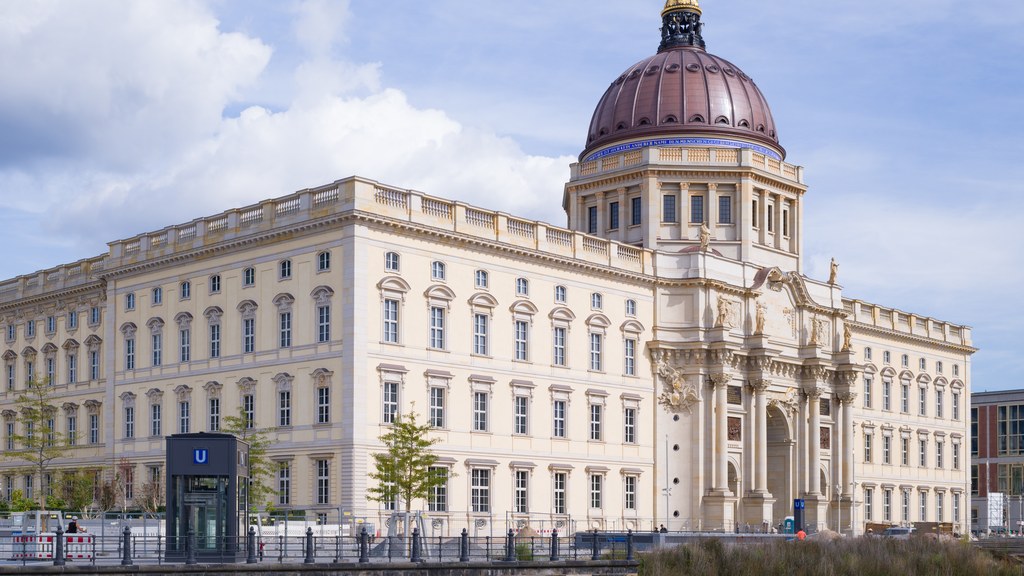
Berlin City Palace cheaper than the Elbphilharmonie?
8 min read
The Elbphilharmonie ultimately cost 866 million euros, more than eleven times the initial public estimate. The Berlin City Palace, a complete reconstruction with handcrafted stone facades, remained at around 680 million. Anyone wanting to seriously understand construction costs should stop equating beauty with price.
Key Takeaways
- Beauty is rarely the cost driver. The Elbphilharmonie exceeded its budget in structural engineering, acoustics, and construction management, not in ornamentation.
- Tradition scales with technology. The Bamberg natural stone workshop Hermann Graser processes natural stone with industrial robots, making detailed work plannable.
- Demand for detail keeps value creation in the country. Where clients demand genuine craftsmanship, qualified jobs are created in small and medium-sized enterprises rather than in an anonymous supply chain.
Related:Productivity over Austerity: How SMEs Will Really Decide 2026 / M&A Rarely Fails Due to Price: 180 Days Decide
Two Cultural Buildings, Two Cost Curves
Two of the most well-known German construction projects of the last twenty years share a common theme: they’re too expensive. The Elbphilharmonie in Hamburg opened in January 2017. Its first publicly communicated cost estimate was 77 million euros, at that time still largely envisioned as a private project and without reliable planning. In the end, the bill came to 866 million euros. That’s not just a cost increase; it’s a different magnitude.
The Berlin City Palace, now home to the Humboldt Forum, tells a different story. It is a complete reconstruction, with three baroque facades rebuilt according to historical models, thousands of handcrafted decorative elements made of natural stone, and a dome. A building that, by any intuition, should be more expensive than a concert hall. It cost around 680 million euros, significantly less than the Elbphilharmonie.
The two buildings are not directly comparable. The Elbphilharmonie includes a hotel, apartments, and an extremely technical concert hall structure, while the City Palace is essentially a museum. Nevertheless, the comparison refutes a common assumption: that the ornate, labor-intensive building is inevitably the more expensive one.
| Elbphilharmonie | Berliner Stadtschloss | |
|---|---|---|
| Final Costs | approx. 866 Mio. Euro | approx. 680 Mio. Euro |
| Initial Estimate | 77 Mio. Euro (publicly communicated) | approx. 590 Mio. Euro |
| Completion | 2017 | from 2020 |
| Main Cost Drivers | Structure, Acoustics, Construction Management | Scope and Construction Time |
Figures rounded, based on publicly reported accounting and forecast values. The early Elbphilharmonie estimate was a non-binding rough figure, the City Palace budget was an already planned amount.
What Really Drove Up the Cost of the Elbphilharmonie
The Hamburg Parliament has investigated the cost explosion in its own Parliamentary Investigative Committee. The findings do not blame marble intarsia or facade figures as the cause. Instead, they cite imprecise budget overviews, incomplete planning at the time of contract signing, subsequent planning changes, and construction management that failed to control the general contractor.
The most expensive individual item was the physics. The large concert hall is suspended as a vibration-decoupled body within the building, acoustically separated from the supporting structure. The curved glass facade was a custom design without precedent. These are engineering feats at the edge of technical possibility. Such tasks have no experiential value by which a price could be calibrated.
The lesson is uncomfortable but clear. Costs explode when no one knows what something costs because it has never been built before. They explode with prototypes, with contracts without finalized planning, with decisions made during construction. Ornamentation does not belong in this list. A facade figure is demanding, but it is a known trade with calculable effort.
A Family Business from Bamberg Provides the Counterexample
What is Natural Stone in Construction? Natural stone is rock such as sandstone, limestone, or granite, quarried directly and processed into facades, floors, or decorative elements without industrial binders. Each piece is created from a single block, not from a mold.
To see what calculable ornamentation looks like, turn to Upper Franconia. The Bamberg natural stone company Hermann Graser is a family business founded in 1965 and is now one of the larger natural stone processors in Germany. The company covers the entire chain: its own quarries for Main sandstone, its own planning and design office, production in the factory, and installation by its own team.
This very company contributed to the reconstruction of the Berlin City Palace. Graser manufactured, among other things, window sills and decorative stones for the reconstruction. For the New Old Town in Frankfurt, the company supplied figures, fountains, and columns for facades and courtyards. The new building of the Criminal Technology Institute in Dresden, in which the company was involved, was awarded the German Natural Stone Prize in 2024.
The decisive factor is not the reference list. It is the method of operation. Graser was one of the first companies to process natural stone automatically with industrial robots. A robot that mills a sandstone into a profiled window sill repeats this work identically and calculably. Tradition and technology do not stand in each other’s way here; they need each other.
The forward-looking view goes even further. Together with the TU Dortmund, the Bamberg company investigated in 2024 how natural stone can be used again as a load-bearing component, not just as cladding. A massive stone structure saves the energy-intensive production of cement and steel and can be dismantled by type at the end. What looks like tradition is an argument for lower life cycle costs here.
Why Detail Isn’t Expensive, But Plannable
In my work with projects, I’ve learned a rule that applies to construction just as it does to any complex undertaking: What becomes expensive is what no one has calculated. It’s not the elaborate details that drive up the budget, but the unplanned elements. A trade with experience, a fixed process, and defined interfaces can be managed, almost regardless of how intricate the result looks.
Natural stone detailing falls into the manageable category once a company organizes it as a process. Quarries supply the raw material, the design office translates the draft into workshop plans, the robot handles the repetitive rough work, and the stonemason takes care of the fine details and the pieces that a program can’t handle. This setup transforms beauty into a trade with a fixed price.
For clients, this means: Those who plan early and hire a company that handles design, manufacturing, and installation in one go eliminate the most expensive risks. Interfaces between many trades are the classic weak point in construction. Every handover is a potential point where plans don’t match up and additional costs arise.
What Drives Construction Costs
- Prototypes without experience
- Contracts based on incomplete planning
- Changes during construction
What Keeps Construction Costs Down
- Proven trades with fixed prices
- Complete workshop plans before contract
- One company for planning, manufacturing, and installation
The counterpoint to this logic is the experimental special solution. A one-of-a-kind curved glass body doesn’t have a fixed price because there’s only one piece. Beauty as repetition is affordable; beauty as an experiment rarely is. This is the point that the comparison of the two cultural buildings makes so clear.
What This Means for the Job Market and SMEs
For entrepreneurs, the more exciting question isn’t what a construction project costs, but where the money goes. A high demand for detail, material, and craftsmanship leads to a certain type of order: to companies with their own manufacturing, their own design offices, and trained specialists. This value creation stays in the country; it isn’t outsourced to an anonymous supply chain.
That’s precisely where the problem lies. The stonemasonry trade has been reporting a shortage of skilled workers for years. The training takes three years, and according to industry figures, over 250 apprenticeship positions were vacant recently. The collective bargaining agreement apprenticeship remuneration will increase to 965 euros in the first, 1,065 euros in the second, and 1,215 euros in the third year of training starting in August 2026. This is a signal, but it doesn’t replace demand.
Demand is created by requirements. When clients, architects, and public authorities demand materials and craftsmanship instead of the cheapest shell, they keep an entire professional field alive. A company like Graser shows that this isn’t a nostalgic business model. Having robots and stonemasons in the same workshop offers young people a profession that combines manual work and high-tech.
The combination of construction, technology, and tradition is therefore not a matter of taste. It’s a matter of location. Beautiful building doesn’t have to be more expensive. Where it succeeds, it finances qualified work right here in Germany.
Frequently Asked Questions
Is it true that beautiful construction can be cheaper than simple?
Not automatically, but it can be. Comparing the Elbphilharmonie and the Berlin City Palace shows that the more ornate building ultimately cost less. The decisive factor is not beauty, but whether a trade is established and calculable or an experimental special solution.
Why did the Elbphilharmonie become so expensive?
Public reviews cite imprecise budget overviews, incomplete planning at the time of contract signing, subsequent changes, and weaknesses in construction management. Additionally, there were technical special tasks such as the acoustically decoupled concert hall and the curved glass facade.
What does the Bamberg natural stone factory Hermann Graser do?
The family business from Bamberg, founded in 1965, processes natural stone throughout the entire chain: own quarries, own design office, production, and assembly. The factory was one of the first to process natural stone automatically with industrial robots.
How do robots and traditional stonemasonry fit together?
The robot takes over the repetitive rough processing and delivers identical, calculable results. The stonemason takes over the fine work and the pieces that a program cannot handle. The technology does not displace the craft, it makes elaborate detail work plannable.
Why is this a question for the job market?
High demands on material and processing lead to orders for companies with their own production and trained specialists. This value creation remains in the country. However, the stonemasonry trade reports a shortage of skilled workers, with industry figures indicating that over 250 training positions were last vacant.
Title image source: Wikimedia Commons / Dietmar Rabich (CC BY-SA 4.0)
Read more on MyBusinessFuture
MyBusinessFutureCloud costs are a top management issue: When CFO and CIO no longer plan side by sideMyBusinessFutureThe partnership that achieves more than any acquisitionMyBusinessFutureWhen AI collaborates instead of assistingMore from the MBF Media Network
Digital ChiefsWhich IT budget survives the cutback roundcloudmagazinAI consumes power, the cloud gets the billSecurityTodayWhere the SMEs still lag behind technically with NIS2Translated from the German original using artificial intelligence. The German version is authoritative.

