
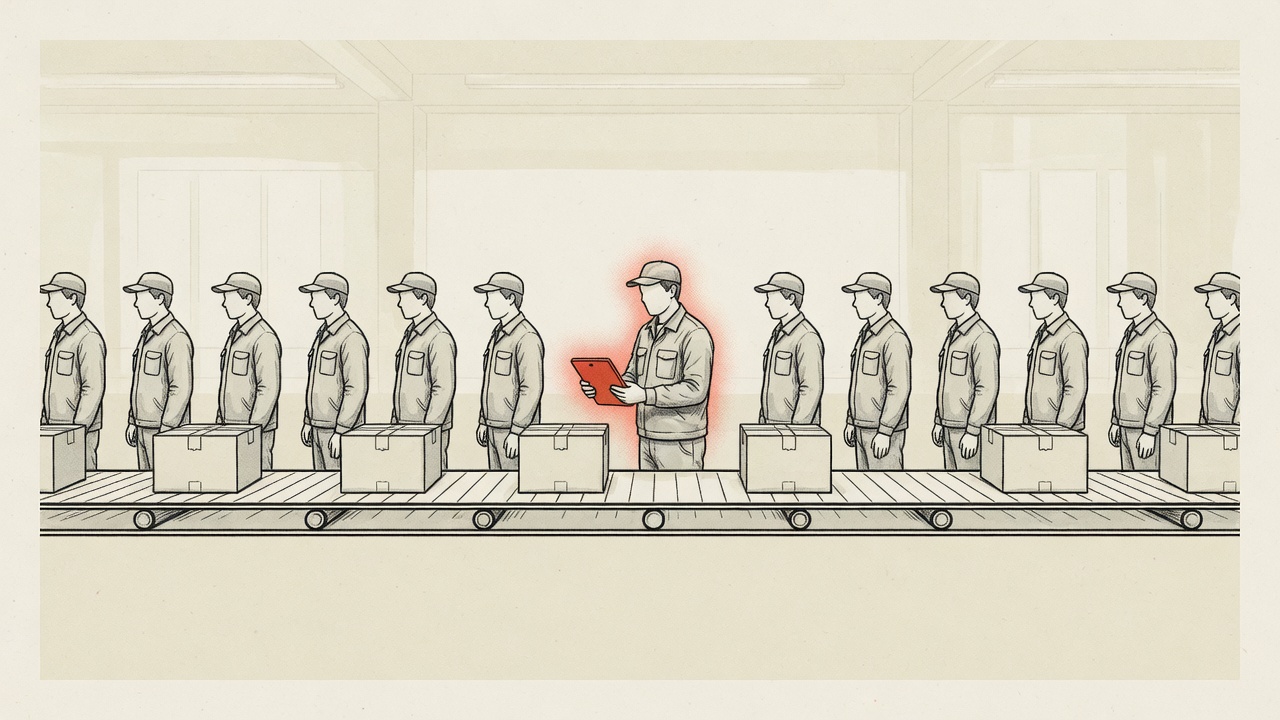
Skills shortage: Logistics relies on AI instead of training
4 min read
On 10 September 2026, Bitkom Vice President Tanja Rückert presented a survey of 502 logistics companies. She called digitalisation the most important answer to energy prices, supply chains and staff shortages. One in two firms already uses artificial intelligence (AI), but only eight percent train all employees for it.
Key takeaways
- Bitkom surveyed 502 logistics companies. Almost three quarters name a lack of know-how as the biggest obstacle to digitalisation.
- More than half of the firms face shortages of couriers, drivers and dispatchers. IT positions remain open at almost half of the companies.
- One in two firms uses AI, but only eight percent train all employees. A quarter trains no one to handle the tools.
- DHL creates 250 jobs in Cologne-Eifeltor. The site increases capacity by adding staff and expanding sorting operations.
Related:Investment backlog: How AI uncovers hidden budgets / New EU tachograph requirement: What fleets need to know now
What is AI upskilling? Training the existing workforce on tools that support routes, dispatch and sorting. Without it, the licence risks sitting unused in the company.
Three quarters of logistics companies lack the know-how
Bitkom published a study on the digitalisation of the German logistics sector on 10 September 2026, surveying 502 logistics companies with 20 or more employees. Bitkom Vice President Tanja Rückert called digitalisation the most important answer to energy prices, broken supply chains and staff shortages.
91 percent of the surveyed firms see digitalisation as an opportunity. For almost three quarters, the lack of know-how is the biggest obstacle on that path. Rückert said the skills shortage is slowing digitalisation while making it all the more urgent.
87 percent of companies name the skills shortage as one of their biggest challenges, directly after high energy prices. The sector is therefore buying tools to address the shortage while leaving the corresponding training largely unaddressed.
Simultaneous shortages of couriers, drivers and dispatchers
The staffing shortage has several names in this sector. More than half of the companies report shortages in each of three roles: couriers, drivers and dispatchers, while IT positions remain open at almost half of the companies. Software meant to close only one of these gaps meets all four in daily practice, because the same shift has to keep track of routes, loads and systems.
| Open role | Share of firms with shortages |
|---|---|
| Delivery couriers | 64 percent |
| Drivers | 55 percent |
| Dispatchers | 53 percent |
| IT specialists | almost half |
| No skills shortage | 4 percent |
Source: Bitkom survey of 502 logistics companies, published on 10 September 2026.
Only four percent of firms state that they currently have no skills shortage. Software intended to address these gaps is therefore deployed in workforces where unfilled routes, vacant dispatching roles and open IT positions strain the same operation at the same time.
A dispatcher plans routes, loads and time windows. When that role is missing, an AI application meant to support exactly this planning is of little use. If IT is missing as well, the application is left without any connection to warehouse, telematics and order intake.
Half the firms use AI and barely train anyone
According to Bitkom, the share of logistics companies using artificial intelligence has more than doubled from 22 percent in 2022 to 51 percent. 55 percent see the technology as a way to address the skills shortage, while vacancies among drivers and in dispatch remain unfilled.
54 percent state that they lack the expertise to integrate AI into their processes. Only eight percent of firms offer AI training to all employees.
A quarter trains none of its staff to handle AI. At those firms the tool stays with a few specialists or sits unused, while couriers and drivers work through the same daily schedule as before. Whether a licence is used in dispatch depends on who receives training in the company.
DHL creates 250 jobs in Cologne-Eifeltor
One day before Bitkom published its study, DHL put the extension to the Cologne-Eifeltor parcel centre into operation. This created 250 new jobs.
Sorting capacity stands at 50,000 parcels per hour according to the company. The workforce at the site rises to 700 employees. DHL couples throughput and staff there in a single step. Additional sorting came with additional employment contracts.
DHL thereby shows the path that, according to the Bitkom figures published the following day, is missing across the wider sector: more throughput with more staff rather than with software alone.
47 percent expect more IT specialists by 2035
47 percent of companies expect rising demand for IT specialists by 2035, while today’s open positions are for delivery couriers, drivers and dispatchers. AI in dispatch and routing needs employees who can operate the tool. Rückert highlighted precisely this gap in the publication. It remains to be seen whether the firms will catch up on training before the next licence is bought.
Frequently asked questions
Why doesn’t an AI licence solve the shortage of drivers?
55 percent of logistics companies see the technology as a way to address the skills shortage. At the same time, 54 percent lack the expertise to integrate it. Without training, the tool sits unused in the company.
Who feels the training gap first?
Only eight percent of firms offer AI training to all employees. A quarter trains no one. Dispatchers and IT operate the tools in daily work before drivers or couriers ever see them.
What does the survey mean for the next licence purchase?
Bitkom identifies the lack of know-how as the biggest obstacle to digitalisation. Only eight percent of firms train all employees. In these figures, a licence without training for dispatchers and IT remains the more common practice.
What does the Cologne-Eifeltor parcel centre show?
DHL put the extension to the parcel centre into operation there on 9 September 2026. 250 jobs were created and the workforce rises to 700 employees. Additional sorting at the site went hand in hand with additional staff.
How many logistics companies already use AI?
51 percent of the surveyed companies use artificial intelligence; in 2022 the figure was 22 percent. 55 percent see it as a way to address the skills shortage.
Read more on MyBusinessFuture
MyBusinessFutureAI in the labour market: Securing jobs with these strategiesMyBusinessFutureSkills shortage 2026: 10 industries & solutionsMyBusinessFutureFujitsu’s AI platform: Three consequences for SMEsMore from the MBF Media Network
cloudmagazinIceberg Won the Format War-Now the Catalog DecidesDigital ChiefsThe Billion-Dollar Bet of Hyperscalers-and Their Cloud CostsSecurityTodayWhen the Reporting Clock Really Starts TickingImage source: AI-generated (September 2026)
Translated from the German original using artificial intelligence. The German version is authoritative.
Also available in

