
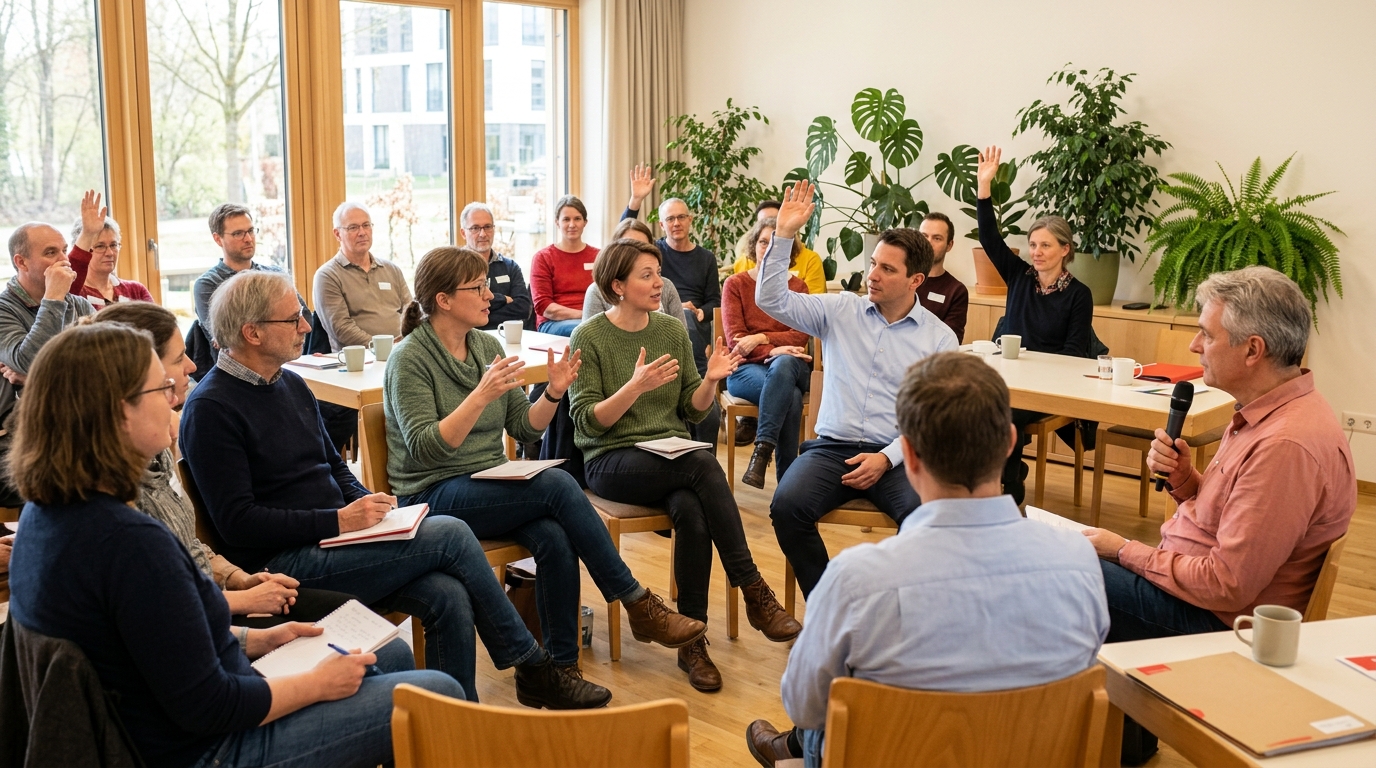
How to Engage Citizens Effectively: The Necessity of Providing Substance Before Seeking Input
7 min read
Citizen participation rarely fails due to a lack of public interest. It fails when administrations cannot deliver after the dialogue. For local authorities, participation becomes an operational issue: those who listen must first clarify who decides, what feedback will be provided, and which resources are available for implementation.
Key Takeaways
- Dialogue is only the visible part. The real work begins before the meeting: mandate, budget, responsibilities, and feedback format must be clearly defined.
- Engagement needs follow-through. People invest time when they see which proposals move forward and what the boundaries are.
- Participation doesn’t automatically cut costs. Well-managed participation reduces conflicts and rework. Poorly managed participation guarantees disappointment.
Related:Citizen-centric governance under staffing pressure / Why GovTech pilots fail before scaling up
The dialogue session is too late to start with
What is an operational plan for participation? An operational plan for participation defines, before the dialogue begins, which decision is still open, who evaluates inputs, what feedback is provided, and which resources are available for implementation. It makes participation internally manageable.
kommunal.de treats participation not as a decorative democracy format but as work on local capacity for action. This is precisely what is often underestimated. A citizen dialogue does not start with the invitation and does not end with the minutes. It begins with the question of which decision is even open.
Many administrations run into difficulties because participation is planned as a communication measure. The specialist department presents a topic, citizens gather suggestions, and in the end there is a results document. Only then does the actual review begin internally. For those involved, this feels like stagnation, even though the administration is working.
A better process reverses the sequence. Before the dialogue comes an operational plan: Which decision is pending, what leeway exists, which proposals can feed into which process, and who responds when. This may sound sobering. But it is the difference between participation as a ritual and participation as a control instrument.
| Clarify before the dialogue | Why it matters | Consequence without clarification |
|---|---|---|
| Scope of decision | People need to know what is negotiable | Proposals bypass responsibility |
| Budget framework | Implementation requires money or staff | Expectations grow without backing |
| Response deadline | Trust is built through answers | Minutes vanish into filing systems |
| Responsible body | A proposal needs an owner | No one drives implementation forward |
Engagement is not a by-product
Participation and volunteering are often viewed separately. In municipal reality, they are closely linked. Those who feel taken seriously in a citizen dialogue are more likely to get involved later in the neighborhood, club, or project. Those who experience that their contributions have no consequences withdraw.
For municipalities, this connection is operationally relevant. Volunteering does not replace a statutory public task. But it stabilizes local infrastructure: culture, sports, neighborhood assistance, fire departments, integration, maintenance of meeting places. Participation can strengthen this commitment if it does not merely collect opinions but opens up spaces for follow-up.
Participation becomes resilient when a contribution leads to a visible next step.
The next step does not always mean implementation. Sometimes a reasoned rejection is enough. What matters is transparency: this proposal is being reviewed, that one falls outside our remit, a third needs a council resolution. This kind of feedback is missing in many procedures.
What administrations should calculate before issuing invitations
First, every participation format requires an internal capacity calculation. How many submissions can be expected, who will cluster them, who will respond, which specialist departments need to be involved. A format without processing capacity is an open inbox with public relations risk.
Second, the local authority should decide which form of participation aligns with the objective. An idea map suits spatial suggestions. A planning workshop suits conflicting objectives. A survey suits sentiment snapshots but not fair weighing of complex interests.
Third, feedback must be planned as its own process. Many participation formats invest 80 percent of their energy in the launch and 20 percent in evaluation. For trust, the ratio should often be reversed.
What breeds mistrust
- Unclear scope of decision-making
- No response to suggestions
- Formats lacking implementation capacity
What builds trust
- Clarify mandate before invitation
- Plan feedback with deadlines
- Make suggestions visibly part of processes
The provider question hinges on organisation, not the tool
For service providers and platform vendors, this leads to a clear conclusion. Municipalities do not need participation software that merely generates more submissions. They need systems and consulting that map internal processing, responsibilities, feedback and council logic. The added value lies in easing administrative burdens after the dialogue.
This is a strong SME topic because it speaks the language of mid-sized businesses: process costs, capacities, expectations, accountability. Participation is then treated not as a soft communication issue but as an organisational performance with clear outcomes.
Sources and anchors: kommunal.de dossier on citizen-centric administration, kommunal.de articles on digital participation, volunteering and municipal communication, vhw context on local democracy and urban development.
Why participation belongs in the budget
In many municipalities, participation is funded on a project basis. For a land-use plan, a neighbourhood concept or a mobility question, there is budget, moderation and communication. After that, routine operations resume. That is where the gap appears.
If participation is meant seriously, it needs recurring capacity. Submissions must be sorted, answered, translated into drafts and fed back to committees. This work is neither a side activity nor pure communication. It is administrative craft.
The budget perspective prevents false promises. A municipality can openly state: for this topic there is scope for decision-making, for that only a duty to inform, for a third initially no funds. This clarity is less glamorous than a sweeping call for participation, but it prevents disappointment.
From Proposal to Responsibility
The hardest phase begins after the collection. Proposals are not yet decisions. They require evaluation, consideration, and ownership. Without structured transition, you end up with a pile of good ideas that go nowhere.
An operations plan can structure this phase. It defines which inputs receive immediate responses, which go to a specialist department, which require political decisions, and which must be excluded for legal reasons. This makes participation fairer for both citizens and administration.
For companies offering participation formats or municipal services, this is the real market opportunity. The value isn’t in the prettiest participation portal. The value lies in what happens after submission: clustering, assignment, response, draft resolution, implementation tracking.
The quiet strength of small formats
Not every issue needs a large-scale participation process. Many municipal questions are better addressed through small, recurring formats: site inspections, roundtable discussions, digital office hours, targeted workshops. These formats are less spectacular but closer to everyday life.
This is especially relevant for smaller municipalities. They can’t maintain a permanent participation department. But they can establish fixed routines that collect and respond to citizen input in manageable cycles. This is organizationally realistic and politically sustainable.
Feedback is the underestimated trust factor
Many participation formats are judged by the number of participants. That number is visible, but insufficient. What truly matters is whether people can see what became of their contributions weeks later. Without this feedback, willingness to participate again declines.
Feedback doesn’t have to fulfill every wish. It must explain. A proposal may be sound in principle yet fail due to budget constraints, ownership issues, building regulations, or political priorities. When these reasons are made transparent, the dialogue remains robust.
For administrations, this discipline pays off by reducing conflict costs. Repeated inquiries, public disappointment, and late corrections waste time. A clean feedback process may seem unremarkable, but it’s one of the most cost-effective forms of municipal trust-building.
The practical starting point is a simple inventory. Which three processes generate the most follow-up questions? Which three meetings are most frequently postponed? Which three pieces of information do citizens or staff regularly lack? This list is often more valuable than a grand strategic presentation because it forces the administration to think from the ground up.
Next comes a low-risk pilot. One department, one process, one timeframe, one metric. After four to six weeks, leadership decides whether to maintain, adapt, or end the approach. This turns modernization into a work routine rather than a state of exception.
External partners benefit from this logic too. It forces offerings to describe their impact in administrative terms: fewer follow-ups, clearer responsibilities, faster resolutions, reduced operational load. These are precisely the effects that resonate in a municipal context because they speak to relief, not trends.
This is what makes the topics relevant for MyBusinessFuture. It’s about leadership, capacity, budget logic, and how public organizations deliver better results with limited resources. The technical component is only part of the equation.
The real value doesn’t come from big promises, but from precise, everyday improvements. That’s the kind of precision municipalities need to justify new approaches internally and explain them to citizens.
Reform becomes measurable progress-not just a label.
Participation doesn’t require a large apparatus, but a reliable routine.
Frequently Asked Questions
What distinguishes participation from public relations?
Public relations informs and explains. Participation opens a defined scope for decision-making. Without this scope, the format remains communication, even if citizens are allowed to ask questions.
Why does participation need a budget?
Because evaluation, feedback, and implementation require working hours. Without a budget, participation becomes expectation production. This burdens both administration and citizens alike.
Which formats work best for small municipalities?
Small municipalities benefit from simple formats with direct feedback: workshops, site visits, moderated Q&A sessions, or digital idea boards with clear response logic.
How can engagement be sustained after participation?
After participation formats, municipalities should offer concrete pathways for involvement: project groups, clubs, sponsorships, working committees, or contact points. Otherwise, the momentum fizzles out with the final report.
What is the most critical success factor?
A clear mandate before launch. If you can’t state what will happen with the results, postpone the dialogue or scale down the format.
Editor’s Reading Picks
Read more on MyBusinessFuture
MyBusinessFuturePragmatic Modernization Triumphs Over Metropolitan Master PlanMyBusinessFutureWhen AI can do everything: why trust is becoming the hardest currency againMyBusinessFutureThree AI Defeats in One Week: Lessons for the Mid-MarketMore from the MBF Media Network
cloudmagazinOnline Forms Without Backend Are Analog Administration with a URLDigital ChiefsSmart Cities: Three Project Types for Municipalities in 2026SecurityTodayCyber Liability in Public Administration: Three Levels, No PlanSource of header image: Pexels / Elias Jara (px:16063800)
Translated from the German original using artificial intelligence. The German version is authoritative.

