
Ludwig Meister: 40 AI Projects Without an In-House AI Department
9 Min. Reading Time
Elisabeth and Max Meister run the technical supplier Ludwig Meister from Dachau in the third generation. In 24 months, the siblings have brought 40 AI pilot projects into the core business, without a dedicated AI department. According to Elisabeth Meister, the applications used cost less than 20,000 euros.
Key Takeaways
- Small steps, fast feedback. In 24 months, Ludwig Meister has brought 40 AI pilot projects into the core business, without a dedicated AI department and using use cases drawn from daily operations.
- Manageable costs. According to Elisabeth Meister, the AI applications cost less than 20,000 euros and save around 70,000 euros in license costs annually.
- Failure is part of it. Elisabeth Meister names four reasons for failed projects: starting with the tool instead of the problem, weak data structures, lack of understanding, and steps that are too big.
Related:Bitkom sees AI widespread and its potential unused / BearingPoint: DACH codes with AI, but barely embeds it
A Sentence from Düsseldorf
“We simply can’t afford to wait.” With this sentence, Elisabeth Meister summed up in May what was on the minds of many family business owners in the hall. Around 130 Mittelstand companies had come to Düsseldorf on May 19 and 20 for WirtschaftsWoche’s “AI in the Mittelstand” conference. Most of them were wondering when the right moment to get started with artificial intelligence had arrived.
The co-managing director of technical supplier Ludwig Meister had an answer made up of numbers. Over the past 24 months, her company has brought 40 AI pilot projects into the core business. There is no dedicated AI department for this.
Elisabeth Meister runs the family business together with her brother Max in the third generation. The two share the management. What she told the audience in Düsseldorf is the story of a dealer in seals, V-belts, and drives who started early on AI, taking many small steps.
What is an ERP system? An ERP system is a company’s central business software. It brings together orders, inventory management, and accounting.
A Trading House Since 1939
Ludwig Meister is a trading and services company founded in 1939. It was founded in Munich and is now based in Dachau. The company supplies industrial businesses with drive technology, tooling technology, and fluid technology. WirtschaftsWoche sums up the range succinctly: “from seals to V-belts, everything for industry.”
| Metric | Value | Source |
|---|---|---|
| Founded | 1939 in Munich, now in its third generation | Company data |
| Employees | around 300 across seven locations | Company data |
| Customers | more than 15,000 | Company data |
| 2025 revenue | 121 million euros | Impulse, February 2026 |
| AI pilot projects | 40 in 24 months | Elisabeth Meister, May 2026 |
| Cost of the AI applications | less than 20,000 euros | Elisabeth Meister, May 2026 |
| Licensing costs saved | around 70,000 euros per year | Elisabeth Meister, May 2026 |
Three service centers with their own workshops complement the sales operation. According to company data, more than three million items are available, more than 85,000 of which the company keeps in stock itself.
A technical wholesaler lives on precision. Every order demands the right item number, the right quantity, and on-time delivery. With millions of items, this generates a flood of documents, orders, and product data. This is exactly where the siblings’ AI projects start.
Two Siblings at the Helm
Max Meister holds an engineering degree. He studied mechanical engineering at TU Munich and, according to his speaker profile, taught Digital Commerce B2B for several years at the Zurich University of Applied Sciences. In 2018 he launched his own German-language B2B podcast on supply chain topics.
On the HandelBar podcast by IFH Cologne, he said in early 2024: “AI is Germany’s chance to boost our economic output and hold our own in global competition.” He doesn’t share the concern that AI costs jobs. In his view, automation prevents errors and takes the load off employees.
Elisabeth Meister tells the company’s AI story at conferences, on the company blog, and on LinkedIn. There, in May, she put into words the idea underpinning the company’s approach: “To me, AI isn’t primarily a technology question. It’s a leadership question.”
From Paper Mountains to Data Flow
The transformation began long before the current AI boom. In the past, Ludwig Meister struggled with mountains of paper and data, the Handelsblatt reported in August 2025. Today, ordering, warehouse management, and data maintenance run largely on autopilot. “We’ve achieved enormous leaps in efficiency,” Max Meister says of this development.
As early as the beginning of 2024, the company was already deploying self-built chatbots. Their purpose was to simplify operation of the ERP system. At the same time, a robot was already at work in-house, independently recognizing and analyzing new articles.
The siblings describe their path with a simple sentence. “We dared to try things out,” the Handelsblatt quotes them as saying. What they mean is many small experiments with fast feedback from operations, without a grand master plan at the start.
Experimenting in Day-to-Day Business
Many Mittelstand companies start with a strategy process. Ludwig Meister started with concrete everyday problems. The review by the Handelsblatt Live editorial team on the conference notes that the company relied on rapid experimentation and skipped a grand overall strategy. Dozens of use cases emerged from this approach.
The list reads like a cross-section of a retailer’s daily business. Software interprets incoming receipts and files them as documents in the ERP system. This process is already in productive use. According to the Handelsblatt, an AI also automatically reads out orders and transfers them into the system. Further applications assist with cost calculations, analyzing customer potential, employee training, and preparing product data.
The magazine Impulse described what this looks like in daily practice back in February. Bettina Lettmair works in sales in Dachau. In the past, she manually transferred customer and article numbers as well as order quantities from emails into the order system. “Basically, I was copying data from left to right. It wasn’t fun,” she told the magazine. Today, a sidebar in Outlook shows her the data for every incoming order, captured by the in-house development LM Magic Orders. Lettmair checks the result and releases the order. For her, it’s “like switching from a bicycle to a car.”
The company mostly builds such tools itself. According to Max Meister, more than 90 percent of the automation solutions are in-house developments, with an IT department of 14 people. The bulk of these projects are implemented by the specialist teams with little support from IT.
A second example concerns product data. Ludwig Meister maintains around three million articles, with up to 80,000 added each year, often with inconsistent supplier data and duplicates. According to the company blog, an external tool would have cost around two million euros. Instead, the company built an affordable solution using programming interfaces. It assigns each article to a class and a shop category in three stages and reads out its characteristics. According to the company blog, this should help customers find what they’re looking for faster. Incorrect orders should also become less frequent.
Each of these applications targets a clearly defined problem. The cost figures come from Elisabeth Meister and cannot be independently verified.
Robots with Voice Commands
The most visible AI application sits in the central logistics hub in Dachau. There, a robotic cell picks up articles and sets them down, known in the trade as pick-and-place. Ludwig Meister discovered the provider at the LogiMAT logistics trade fair in 2023: Sereact, a Stuttgart-based software developer for AI-powered robotics. Just three months later, the system was up and running at the Dachau headquarters.
What makes it special is the training that never happens. “We didn’t want to train the system on two and a half million products, but rather use it proactively right away,” explains Matthias Dambach, head of central logistics, to IT-Matchmaker.news. The two and a half million refers to the product range at the time; today the company lists over three million deliverable items. The system uses a Vision Language Action Model. This AI architecture combines image recognition, language understanding, and gripping movement.
Employees control the robot with rules given in plain language. One example: “Don’t pick items marked with an X.” A gripper with three suction cups of different sizes handles parts of varying shapes. For untested products, the cell decides for itself whether it can relocate an item. “The success rate is between 96 and 98 percent,” says Dambach. He emphasizes that this figure applies across the company’s entire large portfolio.
The robot operates in a warehouse that has been automated for more than twelve years. Ludwig Meister runs an AutoStore system there. According to company information, 37 robots move containers across 110,000 storage locations, holding 97 percent of the goods.
The system continues to grow. A second robotic cell is set to pick individual items for customer orders in the future. The solution is now also used in palletizing, anomaly detection, and quality assurance. In September, the company again reported on the AI robotics in its central logistics on its own blog.
Four Reasons for Failure
Not every project at Ludwig Meister has worked out. Elisabeth Meister speaks openly about it. In Düsseldorf, she named four reasons why AI projects failed within her own company.
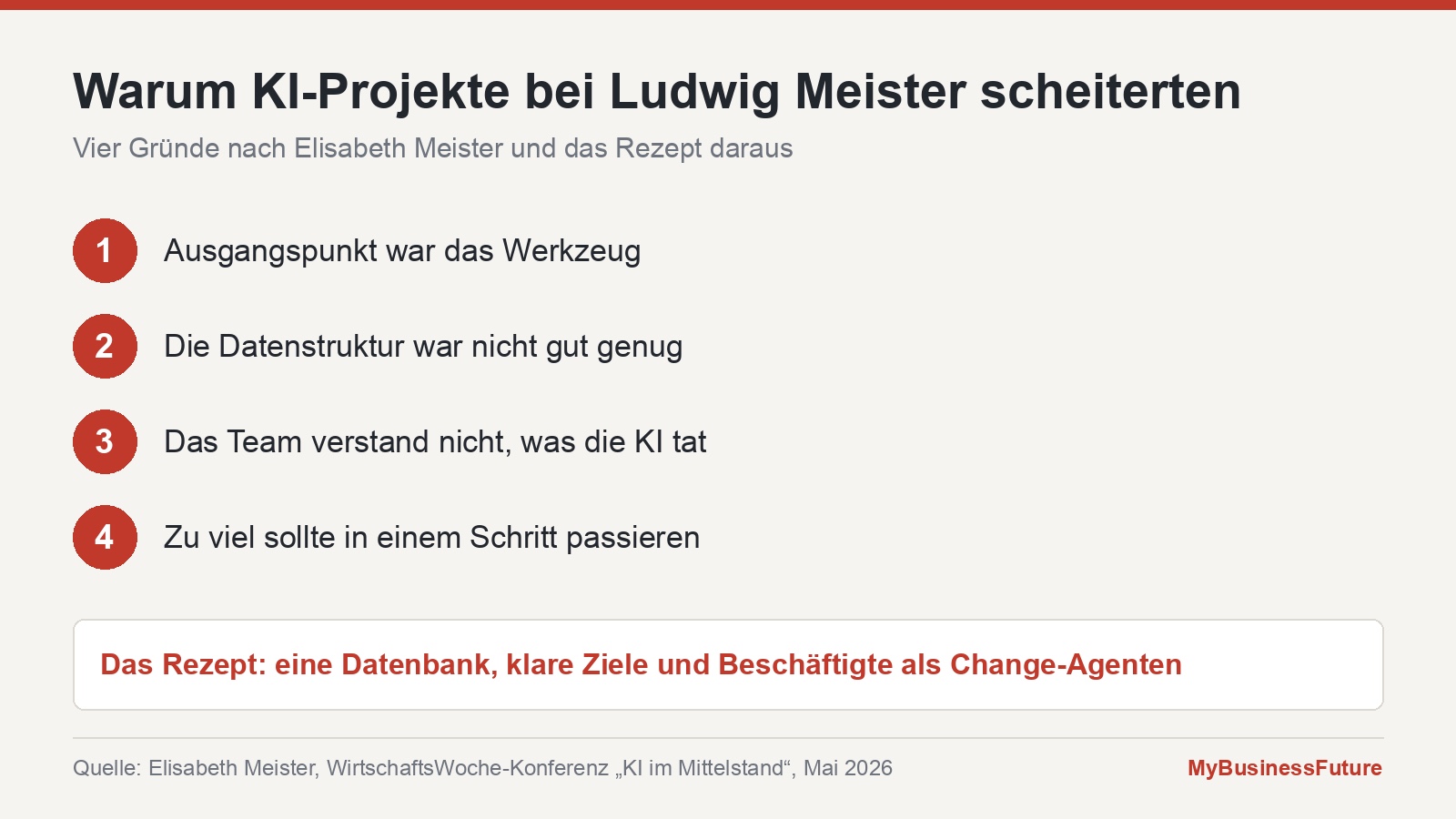
After the conference, she described the mistakes herself on LinkedIn: “We made mistakes along the way too. Some projects stalled because we hadn’t understood the problem well enough. Or because the data foundation was too weak. Or because we wanted too much, too fast.” Stefan Meyer-Spickenagel captured the fourth reason from the talk in a summary on LinkedIn: projects failed when they started from the tool instead of the problem. The company doesn’t publicly say which projects these were.
From these mistakes, the company distilled its own recipe, the “Ludwig Meister Style.” It rests on three pillars: a clear data structure built around a single database, clear goal and solution strategies, and a culture that picks up ideas from the team. In this setup, employees become “change agents.” They drive change in their own area and win over colleagues for new workflows.
Max Meister explained in August, on consultant Andy Huber’s podcast, just how quickly bad data can derail an AI project. In the system, a delivery date of “12/31/2999” actually means “delivery date to be confirmed.” Anyone who doesn’t know that and runs AI over it gets nonsense, as Huber recounts the idea in his summary. Elisabeth Meister sums it up in one sentence on the company blog: “Digitalization and process clarity always come before AI.”
That puts much of the design responsibility on the people who use these workflows every day. Whoever knows the invoice import process best also knows where it snags. A central AI department would first have to painstakingly build that closeness.
Faster Than Average
According to an EU comparison by the IfM Bonn, around 25 percent of small and medium-sized enterprises used AI in 2025, compared with 57 percent of large companies. According to a Bitkom survey for 2025, 81 percent of companies consider AI the most important technology of the future. Only 36 percent actually use it.
By that measure, Ludwig Meister is ahead of the curve. In late August, the Mittelstand-Digital Zentrum Augsburg came to Dachau for a factory tour titled “AI in Practice: From Idea to Productive Application in Business Processes.” Other Mittelstand companies came to see what the path from idea to running application actually looks like.
The Goal Is to Double Revenue
The siblings have set themselves an ambitious target. With AI, Ludwig Meister wants to double its revenue, as Handelsblatt described it. According to Impulse, Max Meister names 2034 as the target year, without adding extra positions. Behind this is also a demographic calculation. Nearly 30 percent of the workforce will retire in the coming years, according to the show notes for a podcast featuring both siblings. Their knowledge from 20 to 30 years on the job is meant to stay within the company. The restructuring continues accordingly. In early October, the company will merge its Aschaffenburg and Raunheim locations into a joint Rhein-Main team.
Elisabeth Meister summed up the core of their approach in June on the company blog: “Companies shouldn’t wait for perfect conditions, but should start solving concrete problems with the right tools. Because especially in the Mittelstand, speed and pragmatism are often the decisive success factors.”
For other Mittelstand companies, this holds a simple exercise. Find an everyday problem that costs time every day. Build or buy a small tool for it. Involve the employees who know the problem best. And then take the next step, instead of waiting for the big breakthrough.
Frequently Asked Questions
How many AI projects has Ludwig Meister implemented?
According to Elisabeth Meister, the company brought 40 AI pilot projects into its core business within 24 months. A dedicated AI department wasn’t necessary for this.
What did the AI deployment at Ludwig Meister cost?
According to Elisabeth Meister, the AI applications used cost less than 20,000 euros. They save around 70,000 euros annually in previous license costs.
What role does robotics play at Ludwig Meister?
In the central logistics center in Dachau, an AI-powered robotic cell from Stuttgart-based provider Sereact is in operation. According to logistics manager Matthias Dambach, the success rate is between 96 and 98 percent, and a second cell is planned.
Read more on MyBusinessFuture
MyBusinessFutureWhy Samsung Is Putting Billions Into MistralMyBusinessFutureGartner: 85 percent want higher AI budgetsMyBusinessFutureBusiness sentiment improves in the MittelstandMore from the MBF Media Network
Digital ChiefsWhy AI Fails at Master DatacloudmagazinCloud ECM: An Entry Point into Digitalization for the MittelstandSecurityTodayHow AI Is Speeding Up Vulnerability DetectionImage source: AI-generated (September 2026)
Translated from the German original using artificial intelligence. The German version is authoritative.


