
Two systems, one invisible loss
Advertisement · in association with the Evernine Group
4 min read
The CRM is paid for, the AI licences are paid for, the agencies are running. What most mid-market companies lack is a number that proves what this money delivers in return. Compact AI Checks provide that number in two to three weeks, in traffic-light format, with an action list for the next shareholders’ meeting.
Key points at a glance
- Paid for twice, barely connected: CRM, AI tools and marketing tools typically run in parallel in mid-market companies. The data sits idle, the return is missing.
- Checks deliver the number within weeks: Three compact analyses for sales, AI visibility and marketing efficiency conclude after one to three weeks with a traffic-light rating and action list.
- The number strengthens the person who presents it: Whoever demonstrates the need for action leads the budget discussion with shareholders, the advisory board and the leadership team.
Related:AI in mid-market companies: The bottleneck lies in legacy systems / Investment backlog: How AI unlocks hidden budgets
Paid for twice, never connected
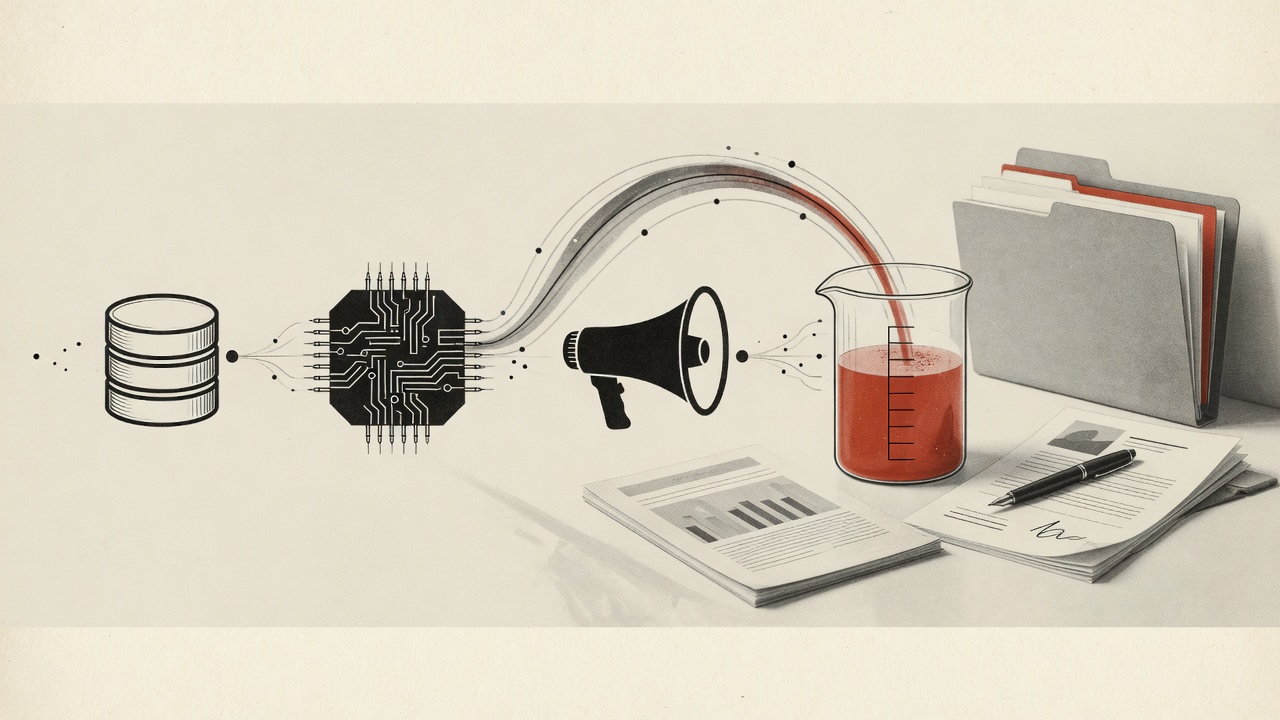
The typical case looks like this: a company with 150 employees introduced a CRM years ago. It is maintained according to the mood of the day. In 2025 AI licences were added because the competition has them too. Marketing works in parallel with half a dozen tools that do not know each other. Every department has its budget. What no one has is an answer to the shareholder’s question of what all this delivers. In this the company is not alone. According to McKinsey, more than 80 per cent of companies have so far seen no noticeable effect of their AI use on results.
This gap costs more than any single licence. CRM records contain customer histories, market signals and revenue patterns that no one ever analyses. Processes that could be automated continue to run manually. The AI that is paid for works on old or unconnected data. It is the silent form of burning cash: nothing breaks, there is simply no monthly return.
What a check reveals in three weeks
What is an AI Check? An AI Check is a compact, numbers-based analysis of a clearly defined area such as sales, market visibility or marketing processes. It takes one to three weeks, evaluates the status using the traffic-light system and concludes with a prioritised action list that leadership can understand without translation. Implementation remains optional.
The Evernine Group has tailored the format to three areas. It was developed from work with Private Equity firms, whose portfolio companies are managed entirely by the numbers: what was invested, what came back, where the next lever lies. The same discipline applies to any mid-market company that must justify its AI expenditure.
| Check | Core question | Result | Duration |
|---|---|---|---|
| AI Sales Check | Does the CRM deliver what it is capable of? | 3 to 5 prioritised use cases with ROI calculation | 2 to 3 weeks |
| AI Visibility Check | Does the company appear in AI answers? | Gap analysis plus action plan | 1 to 2 weeks |
| AI Efficiency Check | Where does the marketing stack lose money? | 90-day roadmap in traffic-light format | 2 to 3 weeks |
Source: Evernine Group service description, 2026.
Visibility is about who the AI cites
The most underestimated area is visibility. Buyers and decision-makers now ask ChatGPT or Perplexity before they open a supplier website. These systems deliver an answer, not a list of results. Gartner expects that classic search volume will decline by around 25 per cent because such assistants answer questions directly. Whoever is missing from the answer leaves it to the competition. The visibility check measures for which questions of the target group a company appears, whom the systems cite and which gaps can be closed with what effort.
The check reveals the gap; closing it is your own work. AI systems prefer to cite sources from established specialist publications. One tool for this is the GEO programme of Evernine Media, which places specialist content in precisely these environments and makes its visibility in AI answers measurable.
Leadership gets a number for the shareholders
There is a side effect that appears in no service description: whoever commissions the check is the first in the company to have a solid AI number. A managing director presents a traffic-light analysis to the advisory board; a marketing director demonstrates to the leadership team where their budget works and where neighbouring departments create friction. The role shifts from justification to initiative. For one’s own position in the company, this is worth more than any software licence.
There is also the agency effect: those who work with external service providers collaborate more effectively with them after the check. The cooperation gains measurable priorities; conversations revolve around traffic-light ratings and effort. This disciplines both sides.
The first step before the next budget
The sequence is deliberately simple: choose the area with the greatest pain, commission the appropriate check, take the result into the next budget round. No consulting marathon, no project team, no eight-figure roadmap. A small, fixed ticket with a clear end. That is precisely what distinguishes a reality check from a major project: it is over within weeks and leaves a basis for decision-making.
Next step
An introductory call with Alexander Roth and Alec Chizhik: 30 minutes, no presentation, one question. Which of the three traffic lights is most likely showing red for you.
Frequently asked questions
For which companies is an AI Check worthwhile?
For mid-market companies that have already invested in CRM, AI tools or marketing and want to demonstrate what is working. The check does not presuppose an ongoing AI project. It assesses the status and prioritises the next steps.
How much internal effort does the analysis require?
Little. What is needed are data access and individual conversations with those responsible. Day-to-day business continues. After one to three weeks the traffic-light result with action list is available.
Does the check oblige you to implement with Evernine?
No. The action list is structured so that internal teams or existing service providers can implement it. Collaboration beyond the check is possible, but not a requirement.
What happens in the introductory call?
Alexander Roth or Alec Chizhik clarify in about 30 minutes which area offers the greatest leverage and whether a check is the right format. Booking runs directly via the calendar in the article.
Read more on MyBusinessFuture
MyBusinessFutureAI in mid-market companies: The bottleneck lies in legacy systemsMyBusinessFutureInvestment backlog: How AI unlocks hidden budgetsMyBusinessFutureSuccession without a successor: Making the company succession-readyMore from the MBF Media Network
cloudmagazinIceberg won the format war. Now the catalogue countsDigital ChiefsThe hyperscalers’ billion-dollar bet and your cloud billSecurityTodayWhen the reporting deadline clock really starts tickingImage source: AI-generated (July 2026)
Translated from the German original using artificial intelligence. The German version is authoritative.


