
AI in Accounting: 78% Dark Entries in SMEs
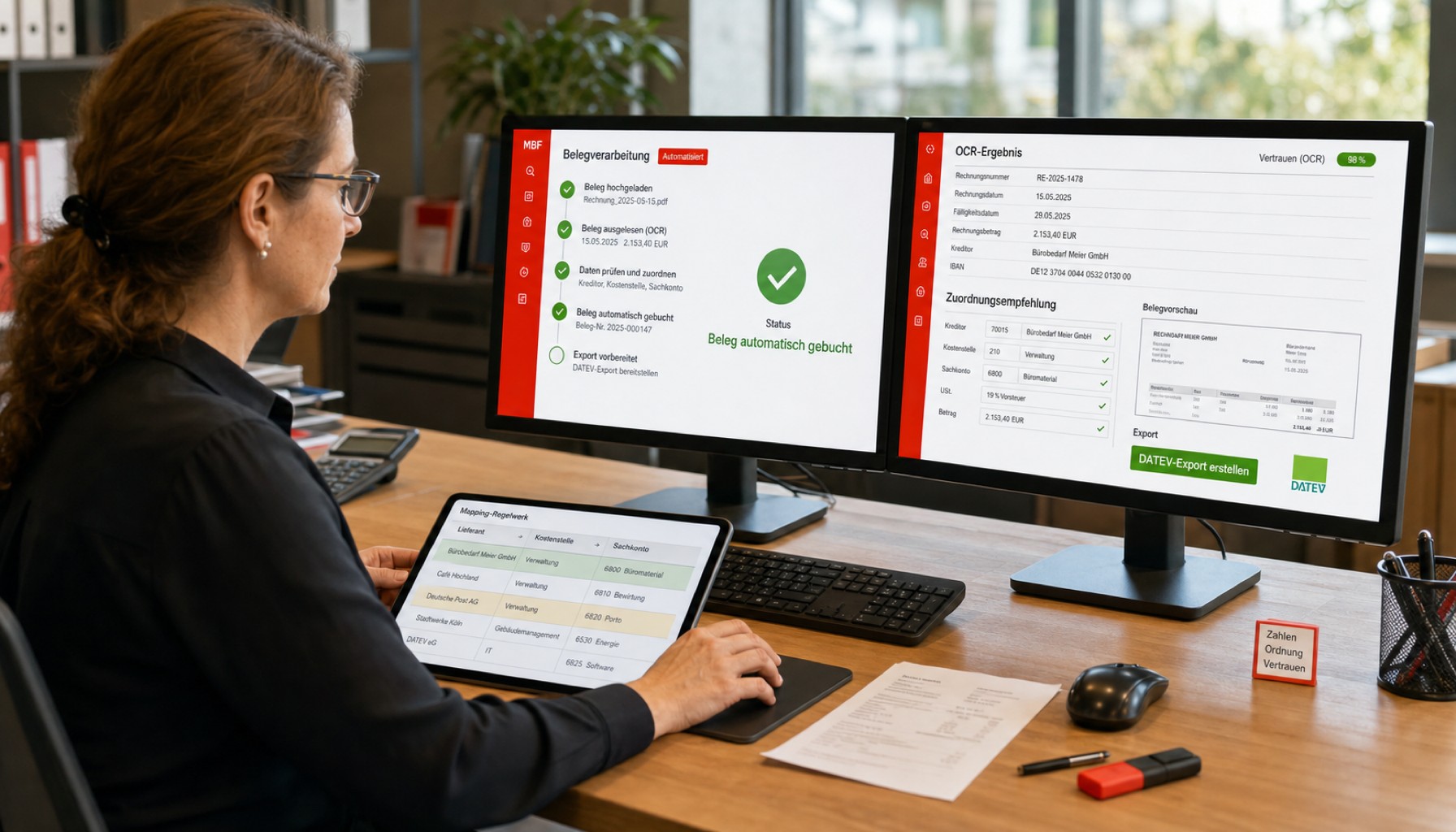
A medium-sized mechanical engineering company from Swabia has had an AI-based accounting system live since February 2026. 14,000 incoming invoices per quarter, three accountants, a seamless pipeline from OCR to accounting to DATEV export. The proportion of documents booked without intervention is 78 percent, compared to zero a year ago. The story is neither a miracle cure nor an efficiency wonder, but an honest trail of decisions that other SMEs can now follow without falling into the same traps.
05/07/2026
Key Takeaways
- 78 percent straight-through processing is realistic: In the DACH mid-market, well-implemented pipelines consisting of OCR, classification, and rule-based accounting can achieve this rate within six to nine months. Anyone promising 95 percent is selling a vision, not a product.
- The hurdle is chart of accounts maintenance: SKR-04 or SKR-03 alone are not enough. The AI needs a mapping layer between supplier behavior, cost centers, and general ledger accounts. This layer requires maintenance, not just setup, and costs 6 to 12 hours per month.
- DATEV remains an interface, not a platform: The value creation of the AI layer occurs before the DATEV export. Tax consultants remain the corrective, not the bottleneck. Anyone who reverses these responsibilities will fail due to the four-eyes principle.
Related:E-invoicing obligation: Conversion by end of 2026 / Cybersecurity tools for SMEs without an IT team
What AI-Powered Accounting Can Really Do for SMEs
What is AI-powered accounting? AI-powered accounting combines OCR document capture, classification and language models, and rule-based posting to create a seamless pipeline. The system learns from historical postings, automatically suggests general ledger accounts, cost centers, and tax codes, and exports the results securely to financial accounting systems like DATEV, Sage, or Lexware. Employees review exceptions instead of manually creating every posting.
The mechanical engineering company from Swabia started with a classic bottleneck in 2025. Three accountants manually processed around 14,000 incoming invoices per quarter, along with travel expenses, creditor maintenance, and debt collection. The team was overwhelmed, one position was vacant, and the market for accountants in the Swabia cluster had been dry for 18 months. Management faced two options: outsourcing to a tax consultant with their own personnel issues or building an in-house pipeline.
The decision was made to implement a modular pipeline. OCR via a DACH provider, classification using a custom fine-tuned model based on Llama-3.2-8B, rule-based posting in a Python layer, and DATEV export via the official XML interface. Six months of development, three months of parallel operation, and then the switch. The first twelve weeks were uncomfortable. Incorrect postings piled up, and the team lost trust. It wasn’t until week 16, when the training data had enough volume, that the mood shifted.
Three Levers for SMEs to Act Now
The interesting decisions in such a project are not those made in the quarterly report, but those made in the third week that go unnoticed. Three levers have proven to be reliably effective in several SME projects in the DACH region.
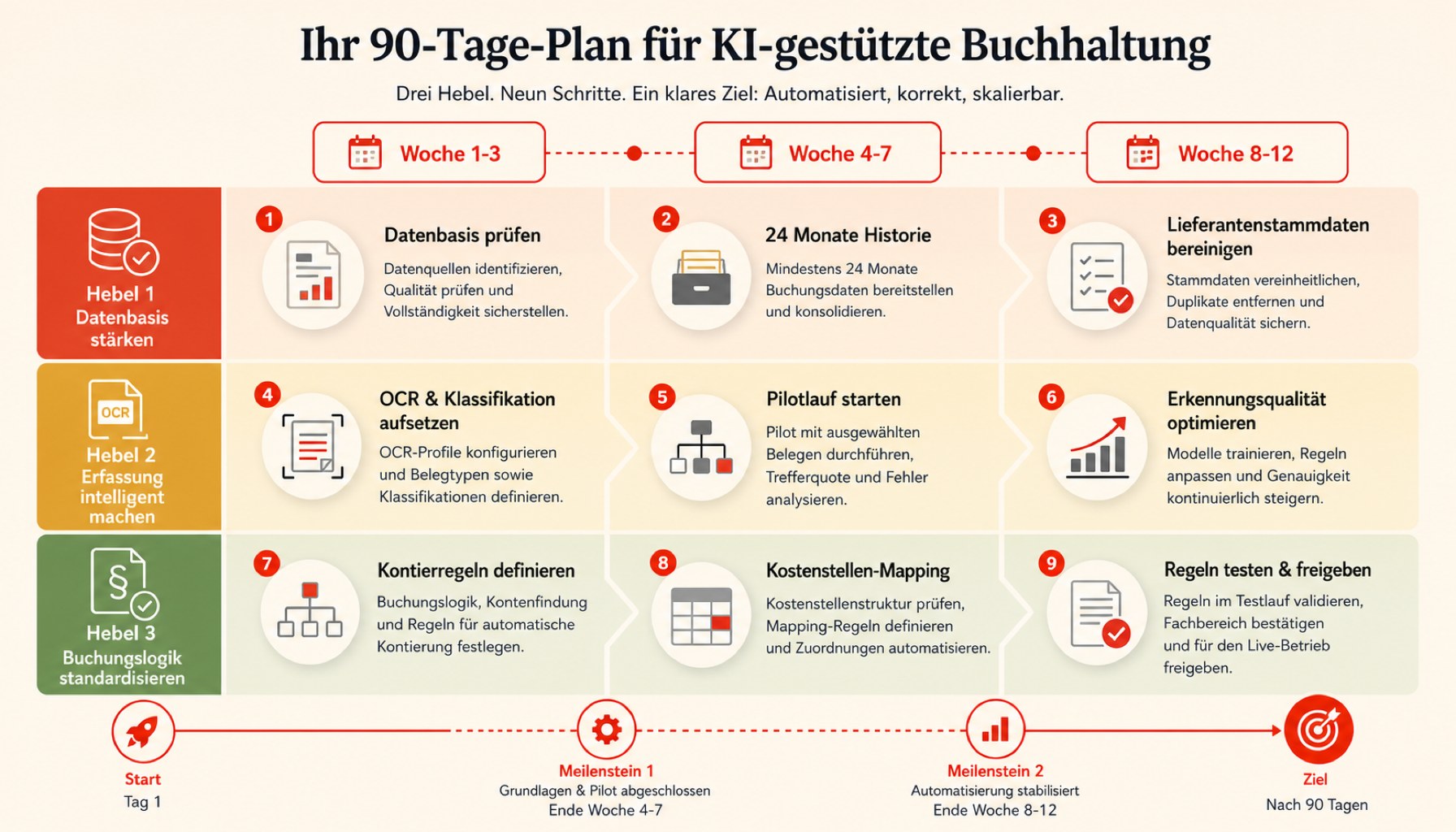
What works, what fails in SMEs
What fails
- Supplier master data without uniqueness. If the same supplier is listed in three different spellings, the AI learns errors permanently.
- Accountants acting as bottlenecks rather than correctives. Requiring every document to be approved before booking loses pipeline efficiency.
- Generic cloud LLM solutions without a DACH data space. GDPR-compliant operation is mandatory; otherwise, accounting falls into a data processing discussion with data protection authorities.
- Management expectations. Expecting 95 percent dark booking within three months sabotages the project through pressure.
What works
- Modular pipeline instead of a comprehensive solution. Each module can be replaced individually, keeping vendor lock-in manageable.
- Rules plus ML, not rules or ML. High-volume suppliers via rules, long-tail via the model; the error rate drops significantly.
- Accounting team actively involved in setup. Employees know the special cases that no model can learn from historical data.
- Quarterly re-training on new bookings. The error rate in the pilot decreased by 35 to 50 percent per quarter without new architecture.
Where the leverage is now
Three SME profiles will have the clearest added value in the next twelve months. Manufacturing companies with high incoming invoice volumes from the traditional Mittelstand, as they are hit hardest by personnel shortages. Service providers with complex travel and expense management, as classification and account assignment per document is most expensive there. And family businesses with generational change, as a modernized accounting process significantly eases the handover. Those without these triggers should stick with their existing accounting and avoid innovation for its own sake.
An honest observation to conclude. Friction in such projects rarely comes from technology but from ownership questions. Who in the accounting team is responsible for model maintenance? Who maintains the chart of accounts? Who decides when a supplier moves from long-tail to high-volume rule layer? Three responsibilities that are still undefined in most SMEs. Those who clarify them early on will enter live operation faster. Those waiting for a complete tooling solution to take care of everything will wait two years longer than necessary. This applies to AI accounting as much as to the question of what a cybersecurity setup in an SME without its own IT team actually needs in everyday life.
Frequently Asked Questions
How long does it realistically take for an AI accounting system to become productive?
Six to nine months from project start to the first productive dark posting. The first three months are data work, followed by three to four months of setup and pilot, and then parallel operation. Going live faster risks losing the trust of the accounting team if the error rate is high in the first weeks.
Which models are suitable for classification in medium-sized businesses?
For DACH SMEs with 5,000 to 50,000 documents per year, fine-tuned 8B to 13B models like Llama-3.2 or Mistral-Small operated locally are sufficient. Those who prefer GDPR-compliant cloud hosting can find suitable options with German providers like Aleph Alpha or OpenGPT-X. Generic US cloud LLMs are technically possible but often raise data protection concerns with the data protection officer.
How does the tax advisor relate to AI accounting?
In most pilot projects, the tax advisor remains a corrective, not a bottleneck. They review quarterly and annual financial statements, clarify special cases, and assume final responsibility. Operational bookings are carried out by the client, and the advisor receives the data via DATEV or a comparable interface. Having the advisor approve every document indicates a lack of understanding of the pipeline logic.
What does such a setup cost for a typical SME?
For an SME with 10,000 documents per year, setup costs range between 45,000 and 90,000 Euro, depending on whether the implementation is internal or external. Ongoing costs are between 1,500 and 4,000 Euro per month for OCR licenses, model hosting, and maintenance. The break-even point compared to an additional full-time position in accounting is typically between months 14 and 22 for most setups.
About the Author
Angelika Beierlein is COO at Evernine. She comes from leadership roles across media and tech-adjacent industries and regularly writes about operations topics where structures matter more than slogans. She believes that honest retrospectives are more valuable than three offsites but are the measure that really brings about change.
Read more on MyBusinessFuture
MyBusinessFutureTrump 2.0 Takes on Three German SectorsMyBusinessFutureAI in CRM ends data silos for RevOps teamsMyBusinessFutureMade for Germany Initiative: Gaps in SME Funding ExposedMore from the MBF Media Network
MyBusinessFutureDORA-TLPT in Q1 2026: Which banks will not pass the first stress testscloudmagazinMini PCs are displacing 1HE servers: Edge computing in German data centersDigital ChiefsThree corporate spin-offs: Continental, Infineon, ThyssenKruppImage source: AI-generated (May 2026), C2PA certificate embedded in image
Translated from the German original using artificial intelligence. The German version is authoritative.

